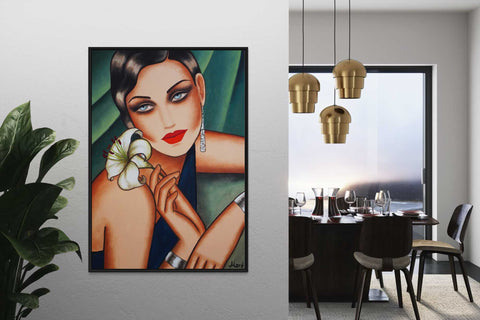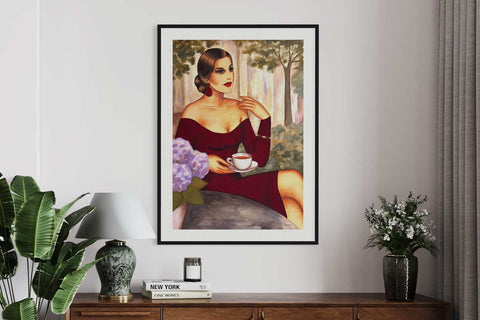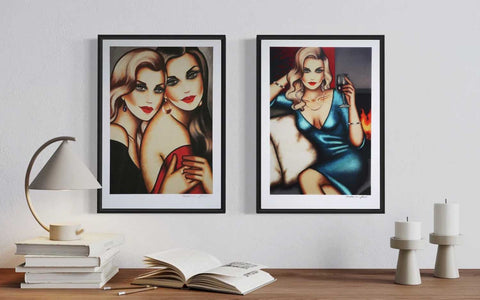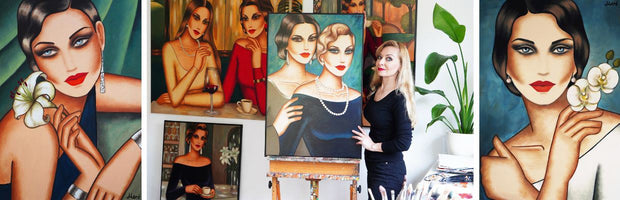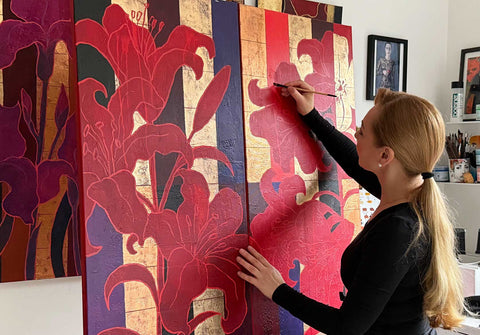
Buying abstract floral art today is no longer a spontaneous decision. Many people consciously compare: original or print? Hand-painted on canvas or technically produced? Those who seek abstract floral art rarely just look for a motif – but for a work that develops presence in a room and touches them long-term.
I often encounter this moment. People feel they want something special but are unsure how to recognize quality. Especially with abstract, floral art, this isn't always easy to grasp. The flower is only suggested, the forms are reduced, much happens between the layers. And yet, it is precisely here that it is decided whether a work possesses depth – or merely looks good.
As an artist, I have been dealing with this fine line for many years. I am not interested in quick approval. I am interested in why some paintings work. Why they continue to move us even after years. In my current work, I combine floral motifs with abstraction, texture, and technical complexity.
This article is an invitation to look more closely. Not analytically, but with feeling. Because quality in abstract floral art is not recognized by reason alone – but by a mixture of perception, experience, and inner resonance.

1. Why abstract floral paintings are so popular today – and what effect they have in a room
We live in a time where something is constantly affecting us. Images, news, opinions, speed. Much is stark, direct, explanatory. Perhaps that's why a new longing arises: for images that don't dictate everything. That leave room for interpretation.
Abstract floral paintings precisely respond to this need. They show nature – but not as a depiction. They extract the essence and omit the superfluous. A blossom becomes movement. A leaf becomes a line. A color becomes a mood. The concrete recedes so that something inner can become visible.
Abstraction allows projection.
You can situate yourself in the image without being told anything. There is no right or wrong. Only perception. And that's exactly what many people find soothing today.
What particularly interests me about floral abstraction is its archetypal power. Flowers have always stood for unfolding, growth, delicacy, and strength simultaneously. They show how vulnerable life is – and how powerful. In abstract form, they lose their cuteness and gain depth. They become symbols for inner processes, for change, for the balance between tension and letting go.
In my works, I combine this organic movement with graphic segments. Lines, surfaces, orders. For me, this is a play between two forces: chaos and structure. Intuition and reason. That which flows – and that which holds. Perhaps this could be described as a balance between feminine and masculine principles. Not in the cliché, but in the original sense: receptivity and clarity, movement and form.
Abstract floral art is so contemporary because it allows both. It calms, it is elegant, it is powerful.

2. Original or print? The decisive differences
At first glance, many images look similar, especially when viewed on a screen. This is understandable, especially with abstract art. A print can look good. Technically perfect. Uniform. Flawless. And yet, you often quickly sense whether you are standing before an original or a reproduction.
A hand-painted original possesses presence.
It carries time within it. Layers. Decisions. Corrections. Doubts. Courage. In an original, nothing is smooth. Nothing is completely predictable. The surface lives. It reacts to light. To movement. To proximity and distance.
In my work, very different techniques converge. Gilding art, squeegee techniques, fine glazes, drawings. Some of these drawings are created long before the actual painting. Others only in the middle of the process. I work with natural templates, with my own photographs of fresh flowers, with studies of Asian ink drawings. I collect patterns, ornaments, structures – and later dissolve them again.
A painting never develops linearly for me.
It grows. Layer by layer. Some layers remain visible, others disappear under new color spaces. Precisely this depth cannot be printed. It is not reproducible. And it cannot be rushed either.
A print always remains on the surface. It shows a result, but not a journey. An original, on the other hand, carries its creation process within itself. And you feel that – often quite intuitively. Therefore, the decision between an original and a print is less a question of budget than a question of relationship. Do you want to look at a real painting? Do you want to surround yourself with real art? When you buy an original floral painting, you are not choosing perfection – but presence.

3. How to recognize quality in abstract floral art
Quality cannot be fully measured. And perhaps that is its very essence.
Of course, color depth, composition, and craftsmanship play a role. But with abstract floral art, there is something else crucial: the feeling that everything is in its place – even if you can't explain why.
After more than 25 years of artistic work, I have learned to trust this feeling. It is not a spontaneous impulse, but a subtle inner knowledge. A painting "works" when tension and calm are in balance. When the eye can wander without getting lost. When there are areas that remain open – and others that provide support.
I consciously work with controlled chance. Squeegee techniques open up areas that I don't fully plan. Colors meet, react, sometimes contradict each other. And then the phase of ordering begins. Lines, drawings, structures are added. It is a permanent dialogue between chaos and clarity.
Quality also shows itself in the courage for abstraction. Not to elaborate everything. Not to explain every blossom. To leave spaces open. Precisely therein lies elegance. A good abstract floral painting trusts that the viewer thinks along – or rather, feels along.
And then there are the traces of time. I love surfaces that don't look new. Metallic surfaces acquire patina, fine scratches, matte zones. Gold loses its shine and gains depth. These traces remind us that nothing valuable remains completely untouched.
Quality is often not immediately recognized.
But if you engage with it, you will truly become receptive to it and learn to appreciate it.

4. Why floral originals have a different emotional impact
Many people immediately feel whether a painting touches them – or if it just looks good.
You linger a moment longer. Your gaze returns. Something inside reacts, without you being able to say exactly why.
Floral originals often evoke precisely this feeling. Because they set something in motion within us. They feel familiar and open at the same time. Like a thought left unspoken – and precisely because of that, it resonates.
Flowers possess a special archetypal power. They stand for unfolding, for the fragile balance between delicacy and strength. A blossom is vulnerable. And yet, it carries enormous energy within it. In abstract form, this tension becomes clearer than in a naturalistic image. The concrete recedes so that something inner can become visible. Room is created for one's own thoughts, memories, moods.
I consciously work with traces of time. Some surfaces are allowed to look older. Metallic accents acquire patina, fine scratches, matte zones. Gold loses its perfect shine. Not to create effects, but to create depth. I am interested in the unfinished, the lived. That which cannot be fully controlled.
The creation process of my paintings begins with sketches, ink drawings, pencil lines. I observe fresh flowers, take photographs, study forms that touch me. Asian ink drawings play a big role in this – their clarity, their reduction, their courage for emptiness. Traditional patterns and ornaments also appear, are abstracted, shifted, reinterpreted. The aesthetic of Art Deco accompanies me like an inner framework.
Then the actual work on the canvas begins. The surface is opened with squeegee techniques, reworked again and again. Colors are layered, glazed, sometimes removed again. Metallic layers are added, disappear again under new color spaces. Drawings appear, dissolve, return. No painting is created in one go. Each carries its own story.
Perhaps it is precisely this multi-layeredness that makes floral originals emotionally different. They say nothing concrete – and yet say a great deal. They invite you to look anew again and again. And they change with the light, with the time of day, with the life that happens around them.

5. Who abstract floral art is particularly suitable for
Abstract floral art is for people who want to experience, not just design, spaces. For people who feel that a painting can do more than just fill a wall.
In the living room, floral originals unfold a special presence. They look noble. They bring calm and at the same time a subtle tension into the room. Through the depth of the colors and the subtle metallic accents, the works react to their surroundings. They reflect light, pick up colors from the room, change with the mood. The painting enters into dialogue – not only with the space, but also with the people who live in it.
In offices, practices, or public areas, abstract floral art develops a similar, almost magical effect. It is inviting without being too personal. Elegant without seeming distant. Especially in waiting areas or reception zones, it can create an atmosphere that supports. That calms. That lifts the gaze without overwhelming.
I believe that precisely in these hectic, restless times, we need this magic. Images that open something important within us. Through their brilliance, their depth, their liveliness. They give the room something that cannot be planned – but is felt as soon as you enter.
👉 More on this:
➤ To the article: "Neo Deco – The New Elegance Between Art, Space, and Time"
My Invitation
If you would like to discover abstract floral art as an original – works that carry time, depth, and sensuality within them – then I invite you to get to know my current works.
Discover original abstract floral art:
6. FAQ – Frequently Asked Questions about Abstract Floral Art
What makes original abstract floral art so special?
A hand-painted original possesses depth, materiality, and presence. The many layers, textures, and traces of time cannot be reproduced.
How do I recognize quality in abstract floral art?
By color depth, composition, tension between order and openness – and by the feeling that a work endures even after prolonged viewing.
Is abstract floral art also suitable for modern spaces?
Yes. Especially in modern interiors, abstract floral art creates an exciting dialogue between clarity and sensuality.
Don't floral motifs look too decorative for office or practice rooms?
Not in abstract form. Reduced floral art appears calm, high-quality, and inviting – without being personal or intrusive.
Is individual commissioned work also possible?
Yes. Size, color scheme, and effect can be specifically tailored to the space and use. Feel free to contact me for personal advice: info@ekaterina-more.com