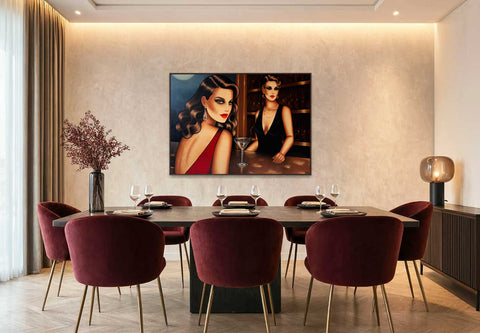
For me, the dining room is one of the most beautiful places for art.
Not because a painting there has to "match the decor" particularly well. Rather, it's because something happens at the dining table that easily gets lost in everyday life: people gather together. They eat, talk, laugh, drink a glass of wine, and sometimes stay longer than planned.
Perhaps that's why motifs related to enjoyment have touched me for many years.
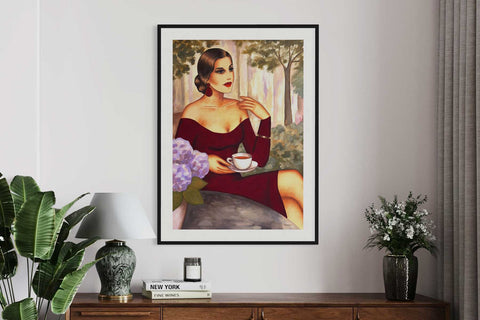
In my own dining area, the painting "Time for Yourself" hangs. It depicts a dreamy woman with a cup of coffee in a scene reminiscent of a Parisian cafe. Warm brown and beige tones meet rich Bordeaux. This painting has been with me for many years.
When everyday life gets hectic, it reminds me of something very simple: to pause for a moment.
To truly drink a cup of coffee. Not to rush through a good meal. Not to let a conversation be interrupted immediately by the next task.
That's precisely where I find a special quality of art in the dining room. I show in more detail how original art can create atmosphere and personality in other living areas in my article "Original Art for Living Spaces – How Art Gives a Home Personality".
It cannot create enjoyment. But it can create an atmosphere in which such moments are perceived more consciously.
Many of my paintings of women and floral works revolve around these themes: coffee, wine, gardens, blossoms, fruits, Mediterranean light. Not as decorative symbols for food, but as images of joie de vivre, memory, and time together.
But which pictures fit in the dining room? Which motifs work, what size does a painting need above or next to the dining table – and does art there even have to be about food?

1. Why art in the dining room can have a different effect
A dining room is experienced differently from many other rooms.
At the dining table, you stay seated. You look at each other, talk to each other, and let your gaze wander around the room in between.
That's why, for me, art here can definitely tell a story.
It doesn't have to be completely calm or neutral. A picture can spark curiosity, create a mood, or keep a small secret.
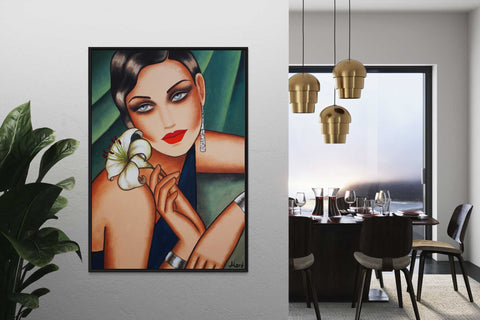
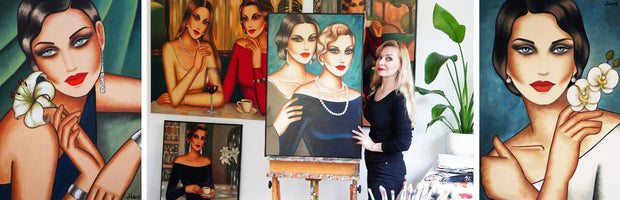
Female portraits, in particular, work very well here.
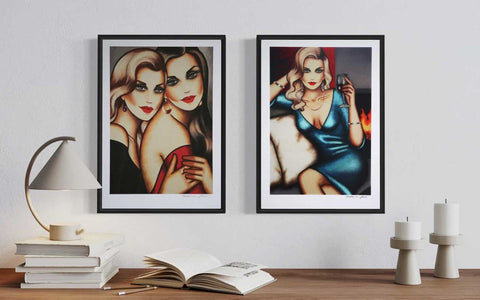
A woman sits at a table with a glass of wine. Another gazes dreamily out of a cafe window. Perhaps she's wearing red gloves, perhaps there's only a cup of cappuccino next to her.
What is she thinking?
Who is she waiting for?
Has she just arrived or is she about to leave?
Such pictures don't dictate a complete story. They leave room for one's own thoughts and memories.
Perhaps a Mediterranean terrace reminds one of a holiday. A cafe picture of Paris. Or a woman with a glass of wine of an evening when one oneself lost track of time.
When a painting becomes part of one's own story
A couple once asked me to paint the woman on the terrace of their favorite restaurant in Mallorca.
The painting was not just a portrait.
It recalled shared holidays, that special place, and the time they had spent together there.
Precisely for this reason, the work became more personal to them than a painting that would merely have matched the decor.
Such commissioned works particularly interest me.
Because then art connects with one's own life.
And that's exactly what I find very fitting for the dining room: a space where memories are not just observed, but constantly created anew.

2. Does art in the dining room have to be about food?
No. At least not literally.
When it comes to pictures for the dining room, one often encounters very direct motifs: wine bottles, coffee cups, herbs, cutlery, or decorative food illustrations.
There's nothing inherently wrong with that.
But for me, it becomes more interesting when a painting doesn't just illustrate:
"Food is being eaten here."
Enjoyment can be expressed much more subtly.
Enjoyment is more than a motif
A woman with a glass of wine doesn't have to be about wine.
Perhaps she tells of a long evening, of a conversation, or of a moment when time didn't matter.
A woman with a cup of coffee can evoke a slow morning.
And oranges, apples, or grapevines don't have to result in a classic fruit still life. They can tell of summer, ripeness, abundance, or of a garden in the south.
For me, enjoyment therefore means much more than food.
It's about perception.
About taste and scent.
About conversation.
About beauty.
And about the ability not to immediately leave a moment behind.
Floral works and the idea of abundance
My floral works can also capture this mood in the dining room.
I am particularly interested in plants with fruits: apple branches, grapevines, oranges, lush leaves and blossoms.
Not because they are supposed to "match the dining room."
I am much more interested in the imagery behind them.
Growth, ripening, abundance, nature.
A floral original can thus bring something of a garden into the room without having to appear botanical or decorative.
Perhaps therein lies the special connection to the dining room:
After all, a good dining table is also more than just a piece of furniture.
It is a place where people gather and life can slow down a little for a while.

3. What size painting fits above the dining table?
When it comes to picture size in the dining room, there isn't one single rule that works for every space.
The dining table is an important reference point – but not the only one.
I always look at the whole picture:
-
How big is the table?
-
How wide is the wall?
-
How high is the room?
-
Where are the doors and windows?
-
How far away are you from the picture?
-
Will the work primarily be seen while sitting or upon entering the room?
Only then does a meaningful size emerge for me.
A portrait format can work excellently in the dining room
Unlike above a wide sofa, a picture above or next to a dining table does not automatically have to be a landscape format.
I find portrait formats in the dining room very elegant.
A work of approximately 70 cm wide and 100 cm high, for example, can fit very beautifully into a smaller or medium-sized dining area.
Female portraits especially benefit from this.
The figure is given space without the painting taking up the entire wall. With a high-quality frame, such a work can also appear very present and valuable.
Square formats create calm
Square paintings also work very well in the dining room.
They appear compact and concentrated and can take a clear position both above a sideboard and on an end wall.
Especially if a room already has many horizontal lines – table top, sideboard, window – a square can provide a beautiful counterpoint.
When a landscape format or diptych makes sense
For a long dining table or a very wide wall, a landscape format can, however, accommodate the architecture of the room.
A diptych can also work excellently here.
Two floral works can together form a large composition without appearing as a massive, closed surface.
The small distance between the canvases introduces rhythm – something that can be very interesting, especially with organic plant forms.
The picture does not have to exactly repeat the table width
Here too, I would not try to mathematically adapt art to a piece of furniture.
A painting can be narrower than the table.
It can also appear more generous on a large, free wall.
The crucial factor is not that the table and picture have the same width.
It's about the proportion within the entire room.
And that's precisely why I find room visualizations so helpful for the dining room.
A format that initially seems large on paper can blend in perfectly naturally on a high or wide wall.
Conversely, a picture that appears large when viewed alone can suddenly seem too small above a long dining table.
The room plays a role.

4. Where should art hang in the dining room?
Not every dining room needs a picture directly above the table.
Sometimes that's exactly where the strongest surface is. Sometimes a side wall, a sideboard, or the end wall of the room works much better.
Therefore, I first look at where the eye naturally falls in the room.
When you enter the dining area: Which wall do you see first?
When you sit at the table: Where does your gaze wander during a conversation?
And which surface has enough calm so that a work doesn't disappear between a lamp, shelf, window, and decoration?
Above the dining table
A picture above the dining table can work beautifully, especially when the wall and table form a clear common axis.
The painting does not have to be mathematically precisely aligned with the furniture. It is more important that the overall composition appears balanced.
A female portrait can be very present here. A floral work often connects the surface more strongly through color, form, and structure.
For long tables, landscape formats or diptychs are particularly suitable. In smaller dining areas, a portrait format can also look very elegant.
Above a sideboard
A sideboard often offers a very calm way to display art.
The artwork can hang a little closer to the furniture, so that both form a unit.
I particularly like this solution when there are only a few items on the sideboard – perhaps a vase, a lamp, or a single object.
This leaves enough space for the picture.
On the end wall
A free end wall can even be stronger than the wall directly at the table.
Especially when you see the picture as soon as you enter the room.
A large-format original becomes a focal point here even before you sit down.
Particularly an intense female portrait or a floral work with strong coloring can thus appear very impressive.
5. Which colors work in the dining room?
I would never choose colors in the dining room based on simple rules.
Not: Red makes you hungry.
Not: Blue is too cool.
Not: Beige is always harmonious.
Such statements are too simplistic for me.
Much more interesting is the question:
What mood should be created in the room?
Warm, deep colors
Bordeaux, deep red, warm browns, and earthy tones can develop a special richness in the dining room.
They evoke wine, wood, fruits, velvet, or evening light – not necessarily literally, but more as a mood.
In my painting "Time for Yourself," precisely these tones play an important role. For me, this fits well in a room where one wants to sit, talk, and linger.
Floral color palettes
Green, blue, or stronger floral tones can also look very beautiful.
In combination with leaves, grapevines, fruits, or blossoms, a connection to nature and garden quickly emerges.
Especially in the darker months, I like this idea: A picture can retain some of summer and abundance in the room without appearing seasonal.
Gold and metallic surfaces
I find gold and other metallic accents particularly beautiful in the dining room.
During the day, they can appear very subtle. In the evening, the surface changes.
The light of a pendant lamp or candles can highlight individual areas. One area begins to shimmer, another recedes.
Especially in my floral works, this interplay is part of the painting's effect for me.
Does the art have to match the decor in terms of color?
Not exactly.
A warm wood tone can be found in the picture. A Bordeaux can correspond with a fabric cover. A strong blue can consciously create a contrast.
More important is that a relationship is created between art and space.
The painting should blend in without being subordinate.

6. Women's portraits, floral art, or pleasure motifs – what fits in the dining room?
All three imagery styles can work well in the dining room. They just create a different effect.
Images of Women – When the Room Should Tell a Story
A female portrait brings a strong figurative presence.
Motifs featuring wine, coffee, terraces, or Mediterranean gardens often resemble scenes from a film. One wonders what the woman is thinking, what happened before, or where she will go next.
Such paintings are well-suited for dining areas where art is intended not just to decorate, but also to tell a story.
If you are particularly interested in this imagery, you can find more about Female Portraits for the Living Room – Hand-Painted Originals here.
Floral Works – When Nature, Color, and Materiality Take Center Stage
Floral originals convey less through a concrete story and more through form, color, structure, and light.
Blossoms, leaves, grapevines, or fruits can evoke gardens, growth, and abundance. In my textured works, relief-like surfaces and metallic accents are added, which change with the light.
Especially in modern or more minimalist dining areas, this can create a beautiful contrast.
More on this imagery: "Modern Floral Paintings for the Living Room – Hand-Painted Originals"
Indulgence Motifs – When Memory and Joy of Life Should Resonate
Wine, coffee, fruits, or Mediterranean scenes can capture the theme of indulgence without becoming classic food motifs.
I am not interested in the wine bottle as an object, but rather in the moment surrounding it: a break, a conversation, a vacation, a slow afternoon.
As a small guide:
-
Female image: more narrative
-
Floral work: more about nature, color, and materiality
-
Indulgence motif: more about memory and joy of life
But in the end, the category is not the deciding factor.
What matters is which work instantly makes you feel: "I want to see that every day."

7. Art in Open-Plan Living and Dining Areas
In open-plan living and dining areas, several artworks are often visible simultaneously. Therefore, I would never choose them completely independently of each other.
A painting above the sofa and a work in the dining area automatically engage in dialogue – even if they come from different series.
Different works can still belong together
The pictures don't need to have the same colors and don't have to come from the same imagery.
Much more important is that they leave room for each other.
For example, a strong female portrait in the living area can beautifully complement a floral work in the dining room. Both can have their own presence without competing with each other.
Consider sightlines
I pay particular attention to which works are visible simultaneously.
A painting that catches the eye upon entering the room needs a different presence than a work primarily viewed up close from the dining table.
Size also plays a role. Two very dominant works can steal attention from each other. It often seems more balanced if one area is more prominent and the other is somewhat calmer.
Connection without Uniformity
For me, an open-plan living and dining area doesn't have to look perfectly coordinated.
A connection can arise through color, material, light, visual language, or mood.
I find this more exciting than an interior where everything looks like a pre-assembled set.
Art should show that individual works were consciously chosen – and don't just fit together because they repeat the same colors.
8. My Personal View on Art and Indulgence
Indulgence appears repeatedly in my work.
Not as luxury in a superficial sense. I am much more interested in that brief moment when one is truly present.
When you don't just drink a cup of coffee on the side. When a glass of wine is part of a conversation you'll remember later. When the scent of oranges or herbs suddenly brings back a holiday.
For me, such moments are precious, precisely because everyday life has often become so fast-paced.
"Time for Yourself" – A Painting That Has Accompanied Me for Years
My painting "Time for Yourself" has hung in my dining area for many years.
The woman sits with a cup of coffee in a scene that reminds me of Paris. Warm brown and beige tones meet Bordeaux, everything seems a little nostalgic and at the same time calm.
I know this painting very well, of course.
And yet, I keep looking at it.
Perhaps especially when I'm doing too many things at once.
The woman in the painting isn't actually doing anything spectacular. She sits, dreams, takes her time.
Sometimes, that's exactly enough as a reminder.
A Little Vacation at Home
Many of my Mediterranean paintings also arise from a similar longing.
Gardens. Vineyards. Oranges. Women in the evening light. Terraces. A glass of rosé.
Not to decoratively bring the South home, but to preserve something of the feeling behind it: warmth, light, slowness, time for each other.
A customer once told me that with a Mediterranean work he had bought for his family, "the sun rises" every time he enters his dining room – even in winter or on a gray, rainy day.
Such feedback touches me deeply.
A painting doesn't change the weather outside.
But it can keep a memory alive.
The Longing for Paradise
For me, fruits, gardens, and blossoms carry another layer.
Gardens have appeared in art and literature for centuries as images of abundance, beauty, and an ideal place.
What interests me most about this is the human longing behind it.
For light.
For peace.
For a place where, for a moment, everything seems right.
Perhaps that's why I love painting ripe grapes, apples, or oranges.
They tell of a moment when something has reached its peak.
You can't hold on to it.
But you can perceive it.
And perhaps that is precisely indulgence.
9. Choosing Original Art for the Dining Room – My Consultation Approach
When selecting a painting for the dining room, I don't start with the question of which color matches the chairs.
I am primarily interested in:
What atmosphere should be created at this table?
Should the room feel vibrant and sensual? Calm and elegant? Mediterranean? Narrative?
After that, I look at the room itself: wall width, table size, ceiling height, light, and sightlines.
Especially in open-plan living and dining areas, it's also important which other works are visible simultaneously.
Room Visualization Before Purchase
If several works or formats are being considered, I like to work with digital room visualizations.
Usually, a photo of the dining area along with some approximate measurements is sufficient.
This helps to determine if a work appears too small, if a larger format fits naturally into the space, or which imagery is most convincing.
This is particularly helpful for couples, as it allows them to see the work directly in their own space, rather than just discussing size or color in abstract terms.
Those generally considering purchasing an original will find further advice on selection, originality, and purchasing decisions in my article "Buying Original Paintings – A Guide for Beginners and Art Lovers".
Existing Original or Commissioned Work?
Often, a suitable work can already be found among my available pieces.
However, sometimes there is a desire for something more personal.
This could be a specific format, a particular color scheme, or a memory that should be incorporated into the painting – such as a favorite restaurant, a trip, or a Mediterranean garden.
In such cases, an individual commissioned work can be the right solution.
If you are looking for an original for your dining area, you are welcome to send me a photo of the room and the approximate measurements. I can recommend suitable works and formats and, if desired, create a digital room visualization.
Discover current original paintings in my online gallery
or
Request personal consultation: info@ekaterina-more.com
FAQ – Art for the Dining Room
What kind of pictures are suitable for the dining room?
Pictures that create an atmosphere and personally appeal in the long term are suitable for the dining room.
These can be female portraits, floral works, Mediterranean scenes, or motifs revolving around wine, coffee, fruits, and indulgence.
What matters less is that the motif literally relates to food, but rather the mood it brings to the room.
How large should a picture above the dining table be?
The appropriate size depends on table width, wall space, ceiling height, and viewing distance.
A work does not have to be exactly as wide as the dining table.
For long tables, landscape formats or diptychs can work very well. In smaller or medium-sized dining areas, a portrait format can also look surprisingly elegant.
How high should a picture above the dining table hang?
That depends on whether the work hangs directly above the table, above a sideboard, or on a free wall.
It is important that the picture does not hover too high and still visually belongs to the dining area.
Therefore, I do not only orient myself by a general eye level, but by the entire wall and how the work is perceived sitting and standing.
Is a female portrait suitable for the dining room?
Yes, very much so.
A female portrait can develop a strong narrative presence in the dining room.
Especially motifs with wine, coffee, gardens, or Mediterranean scenes fit well because they evoke indulgence and contemplation without being blatant.
Does large-format art also work in a smaller dining room?
Yes, if the proportions are right.
A large picture can even make a small room appear calmer than many small wall pictures.
Crucial factors are free wall space, ceiling height, and viewing distance.
A digital room visualization can help to realistically assess a larger format before purchase.
What kind of art suits an open-plan living and dining area?
In open-plan living and dining areas, multiple works should not necessarily look identical, but they should communicate with each other.
This can happen through color, material, intensity, or visual language.
For example, a strong female portrait in the living area and a floral work in the dining area can beautifully complement each other if both are given enough space.