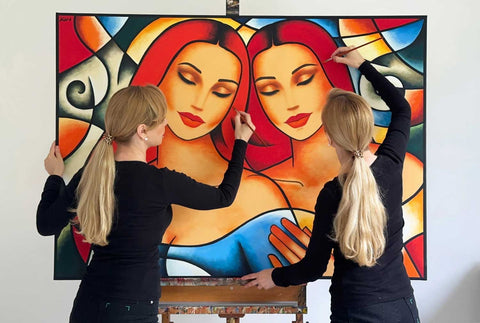
Sometimes I sit in my studio, surrounded by unfinished canvases, sketches, and to-do lists. The colors seem to call to me, but my mind is racing with thoughts: planning new series, preparing social media posts, answering emails, bookkeeping, shipping, organization. And amidst it all, that quiet but persistent voice asks: Couldn't you do a little more?
I love my work – it is expression, passion, and calling all at once. But precisely where everything should be about feeling, depth, and authenticity, there is a danger of losing oneself. In the world of art – and especially emotional art – the desire for constant improvement is seductive. One wants to grow, develop, create something new. And yet, sometimes one loses access to what truly makes art meaningful: vitality, authenticity, and soul.
Perhaps this is true femininity in art – recognizing the point where "doing more" no longer helps. For true beauty arises not from control, but from surrender.
1. Self-optimization and the Loss of Lightness
In a world obsessed with efficiency, performance, and perfection, self-optimization is often celebrated as a virtue. We track our steps, plan every hour, analyze our feelings – as if we were a project that could be managed. But at some point, this urge to improve tips into something that robs us of our lightness.
I see this mechanism not only in everyday life but also in artistic creation – and especially in our female self-perception. We live in an era where many women view themselves as an unfinished work of art: constantly in the process of creation, never complete, always a brushstroke away from the "better version."
Today, many not only retouch photos but their entire self-image – like a constant correction of a painting that is never finished.
This attitude also shapes our modern images of women. They show strength and beauty, but often without room for vulnerability. Yet, true charisma lies precisely there – in the unplanned, in the imperfect, in the moment when the paint accidentally begins to run.
Perhaps it's not about "optimizing" ourselves, but about feeling ourselves again. For lightness is not a state one achieves – it is a feeling that arises when one stops correcting oneself.

2. Perfectionism and Female Self-Perception in Art
When I look at art history, it's striking how differently women have been depicted over the centuries – from idealized goddesses to mysterious muses. Femininity in art was long a mirror of male desires, not an expression of female self-perception. Today, much has changed, and yet the pressure remains: to be beautiful, strong, successful, desirable – and effortlessly so.
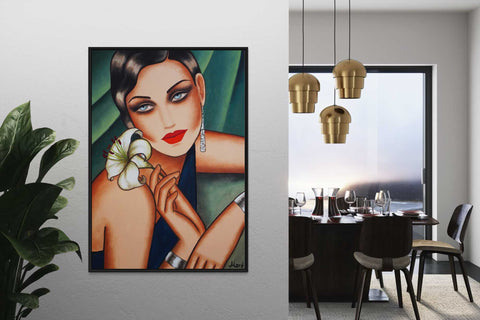
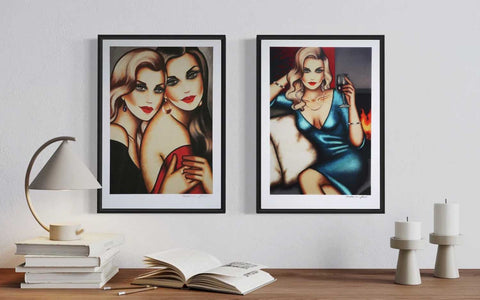
This ambivalence constantly inspires my work, including my series of Femme Fatale Art. The Femme Fatale embodies the conflict between sensuality and self-determination: a woman who fascinates, yet simultaneously eludes the gaze. She represents power – but also the burden of projections that women have carried for centuries.
In my own works, I try to make this contradiction visible: sensual art that not only seduces but touches. For true beauty lies not in perfection, but in presence. A gaze that is powerful. A posture that is self-evident. Strength full of tenderness.
Perhaps today we don't need new ideals, but new truthfulness. Femininity can be soft and strong, sensual and deep, vulnerable and free all at once. And that is exactly what I want to show in my original paintings.
👉 Discover more:
➤ To the article: "Femme Fatale Art – 7 Women's Portraits with Style and Sensuality"
3. The Cycle of Self-Optimization: Why We Are Never "Finished"
Self-optimization is a silent driver. It whispers to us that we are only valuable if we become better – more productive, fitter, more interesting. This pursuit releases dopamine, a brief feeling of happiness that quickly dissipates. Emptiness follows – and the next attempt to fill it with even more achievement.
Even when painting, I feel this urge: to make the picture even more beautiful, more complete, more perfect. But sometimes, that very thing destroys the magic of the moment. Too much will takes the breath out of the color. Too much control extinguishes the living.
The same happens in life. We compare ourselves, measure ourselves against others, chase fleeting ideals – and overlook that we are already in the midst of abundance. Art with meaning does not arise from optimization, but from sensation. It reminds us that beauty and depth grow from the unpredictable.
Emotional art is therefore not a luxury, but a counterbalance: a visual pause in a world that is moving ever faster. Perhaps that is its value – it shows that you don't have to be perfect to be complete.

4. From Compulsion to Inspiration: What Art Taught Me About Imperfection
In my artistic journey, there were many moments when I believed everything had to be flawless. Only with time did I understand: the imperfect carries the greatest truth. A color gradient that flows differently than planned can suddenly make a feeling visible that one didn't even intend to express – and that's precisely what makes it real.
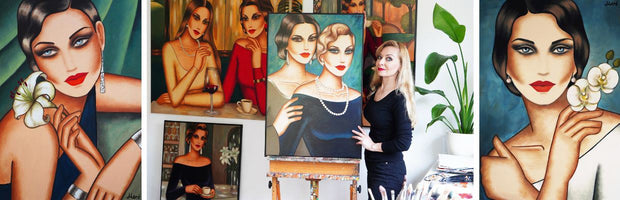
In my styles Feminine Glamourism and Flowism, it's not about control, but about rhythm, surrender, and flowing energy. When I paint, I follow a mood rather than a plan. This is how images of women emerge that are not only aesthetic but alive – a play between intuition and structure.
Even in my commissioned art, I often feel how much women seek this balance. Many desire a portrait that shows their inner radiance. It's less about depiction and more about resonance – about what one feels when one recognizes oneself.
For me, mistakes are not flaws, but traces of life. Every brushstroke tells that something was dared. And perhaps that is the meaning of art: to remind us that beauty resides not in perfection, but in truthfulness.
5. Small Steps, Big Impact: The Art of Balance
Sometimes we forget that growth doesn't have to be loud. In nature, everything happens in subtle, barely visible steps: A bud doesn't open through pressure, but through sun, time, and trust. Why, then, do we believe that our inner growth works differently?
Even in painting, it is often a small brushstroke that gives a painting depth. The big picture emerges from many small decisions – from the courage to pause occasionally and feel if it still feels right.
When was the last time you didn't improve yourself, but simply felt?
Perhaps that is precisely the art of balance: in conscious slowness, in moments where nothing has to arise – and yet everything grows.
Emotional art reminds us of this principle. It is not an escape from everyday life, but a counterpart. A silent "yes" to life that does not want to be perfect, but real.
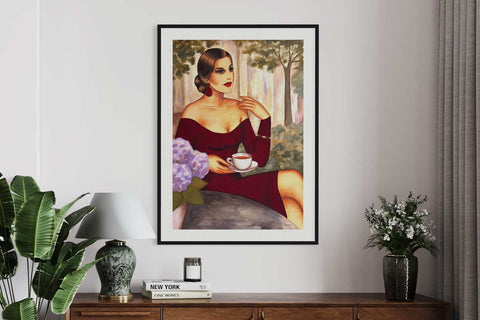
My series Dolce far Niente celebrates exactly this feeling – the beauty of pausing. It is an invitation to all epicureans who long for moments where life can simply be.
👉 Discover more:
➤ To the article: "Flowism: Femininity, Joy of Life & Modern Art in Flow"
➤ To the article: "Flow Meets Flowism: The Path to Creative Lightness"

6. Do Less, Feel More: A Plea for Sensual Art and Authentic Presence
Allowing oneself to do less occasionally opens up space for feeling – and that's where true creativity begins. I believe the greatest form of freedom lies in choosing one's own pace. In a world that celebrates speed, slowness is almost an act of rebellion.
Sensual art thrives on this attitude. It doesn't ask you to "understand" something, but to feel it. Color, light, and form merge into a language beyond words – one that brings us back to the here and now.
Even when painting, I feel: When I stop controlling, something deeper emerges. Something that wasn't planned, but is true. Perhaps that is the secret of all creative power – it needs space, not pressure.
Emotional art for me is therefore not a goal, but an attitude. A way to encounter oneself – in seeing, in feeling, in being.
If you long for more peace, sensuality, and presence, you might find it where color becomes language:
➤ Discover women's portraits in my online gallery now
7. Find Your Balance – in Art, Color, and Emotion
Discover paintings that remind you of what is already within you: peace, sensuality, and joy of life.
My emotional women's portraits arise from the desire to "have to" do less – and to feel more.
Every brushstroke tells of presence, femininity, and the art of enjoying life.
If you are looking for art for your living room that is more than just decoration – but a companion on your inner journey – then let yourself be inspired.
👉 I would be happy to advise you on available works and possible commissions: info@ekaterina-more.com
8. FAQ – Frequently Asked Questions about Emotional Art, Self-Love & Inner Balance
Why can emotional art help reduce stress and performance pressure?
Emotional art appeals to the right hemisphere of the brain – the seat of our intuition. It soothes because it doesn't judge, but allows us to feel. When contemplating it, thoughts dissipate, and space is created for silence and inner balance.
Which paintings by Ekaterina Moré address self-love and self-acceptance?
Works like "Sensual Summer Daydreams" or "Dolce Far Niente" celebrate the human, imperfect – and make it beautiful. They remind us that true femininity lies in authenticity, not in perfection.
How does this topic fit into commissioned art?
Many of my clients want a portrait that doesn't depict them photo-realistically, but shows their inner radiance – that is true commissioned art. It arises in the dialogue between soul and canvas, between reality and feeling.
What does "Art for Epicureans" mean?
Art for epicureans stands for works that don't preach, but touch. They invite you to experience life with all your senses – a glass of wine, a moment of peace, a gaze translated into color.