Discover how high sensitivity can enrich your life!
Do you often feel overwhelmed by the world?
In this article, you'll learn how art and creativity can help you transform inner chaos into strength and clarity.
I share my personal journey as an artist, from oppressive stress to blossoming creativity, and show you how you too can cultivate your own inner garden.
Let practical tips and profound insights motivate you to recognize and use your high sensitivity as a gift. Immerse yourself in a world full of colors, emotions, and self-discovery – it's worth it!
Table of Contents
- From Inner Chaos to a Blooming Garden
- High Sensitivity - Curse or Blessing?
- The World of Artists
- Highly Sensitive People in "Normal" Professions
- These Questions Could Help You Recognize Your High Sensitivity
- The Challenges - and How to Deal with Them
- Understanding Yourself Better and Communicating Better with the World
- How Art Helped Me Find My Way
- Your Inner Garden - and How You Can Discover It
- Final Words: Your Journey Matters
High sensitivity means perceiving the world more intensely – whether sounds, moods, or thoughts – and sometimes that can be overwhelming. But did you know that art and creativity can help you draw inner strength and clarity from this chaos?
Do you know the feeling that the world is simply too loud, too bright, or too chaotic? For many people, such moments are fleeting. For us highly sensitive individuals, however, it's part of everyday life. Our senses are constantly receiving. We perceive everything more intensely – sounds, the moods of others, even our own thoughts swirl incessantly in our minds.
As an artist, I experience this mixture of deep feeling and the challenge of processing all these impressions very intensely. But instead of sinking into it, I have learned to use my high sensitivity as a source of creativity and fulfillment. Today, I want to tell you how I found my way to turn this inner chaos into a blooming garden.

From Inner Chaos to a Blooming Garden 🌺
A few years ago, around 2018, I felt truly overwhelmed by the world. Everything was simply too much: the constant overstimulation, the worries I absorbed like a sponge from my surroundings, and the endless dismal news that seemed to crush me. Then, when the pandemic broke out in 2020 and the world completely lost its mind, it was almost like a premonition that became reality for me.
My art, which otherwise always brought light and joy into my life, suddenly seemed to disappear into darkness. Do you know that feeling when your inner compass no longer works and you're just driven? That's how I felt. My inner garden – the source of my creativity and joy of life – seemed to have become a dried-up desert.
Everything that had previously fulfilled me – my artistic projects, the organization of my work – suddenly became arduous. I felt empty, burnt out, and often asked myself: "Was that really all there was?"
But then something happened. Not a big, spectacular event, but a quiet, barely audible whisper. A whisper that slowly led me back to my inner images. I began to focus on the true meaning of my art – not to prove something to the world, but to rediscover myself. It was as if, in the midst of this desert, I found a small seed that I decided to nurture. And slowly, step by step, that seed began to grow.
High Sensitivity - Curse or Blessing? ✨
Before I continue telling my journey, let's pause for a moment and talk about high sensitivity. Many people think high sensitivity is a kind of "over-sensitivity" or weakness. But that's not true. Highly sensitive people simply perceive the world more intensely. We feel more deeply, process impressions more slowly, but more thoroughly.
This isn't always easy, especially in a world that's geared towards speed and efficiency. But high sensitivity also brings gifts. Our heightened perception is often the key to great creativity, empathy, and deep reflection.
We see the world not just in black and white, but in all its colors, shades, and nuances. For me as an artist, this is an inexhaustible source of inspiration. It means that I see and feel details that others might miss, and that gives my art depth and meaning.

The World of Artists ✨
When I look around my creative environment, I notice that many artists are highly sensitive. I hardly know a musician, writer, or actor who isn't somehow touched by this sensitivity. Creative professions magically attract highly sensitive people because they can productively use their sensitivity here and are often among like-minded individuals. In the art world, these qualities are not only accepted but often celebrated.
Artists are allowed to be "different." We are expected to be eccentric, not to fit into rigid social norms. Our sensitivity and our knack for moods are more appreciated than ridiculed in creative circles.
But life as an artist also brings its challenges. Although it often seems on social media that being an artist is easy and glamorous, the reality is different. We often struggle with self-doubt, comparisons, inner pressure – and all this in addition to the creative work. Nowadays, artists also have to be entrepreneurs. We organize projects, create content, network, do marketing, handle bookkeeping – and all this while our high sensitivity sometimes pushes us to the limits of our resilience.
It's not easy to walk this path. But I take my hat off to all my artist colleagues who, despite all these challenges, stay on their creative path. They have the strength to create something beautiful from the challenges – and that is truly admirable.
Highly Sensitive People in "Normal" Professions ✨
High sensitivity is not only found in the creative field. Even in so-called "classic" professions – whether as tax advisors, IT specialists, lawyers, engineers or entrepreneurs – there are many people who use their fine sensitivity and perceptiveness, often without consciously realizing it. I have met many such people. They long for a balance to their often "dry," stressful, or routine work. And many don't even know that they are actually highly sensitive.
Some end up in professions dominated by numbers and facts because they can create a clear, structured world for themselves, where they find refuge from emotional chaos. Numbers are predictable, facts are reliable. But eventually, many realize that this security doesn't fully cover their deep needs. Order and regularity only temporarily mask what the soul truly craves: meaning and depth.
Others, in turn, consciously use their high sensitivity, for example, in marketing or communication. They have a fine sense for moods and needs and can therefore empathize well with others. But here, too, the danger of overload lurks, because this constant emotional sensitivity can quickly lead to exhaustion.
The beautiful thing about it is: no matter what profession you work in – your high sensitivity can be a great strength. It gives you the opportunity to perceive things that remain hidden from others. However, it is important that you constantly create space for yourself so that you don't get lost in the hustle and bustle of everyday life.

These Questions Could Help You Recognize Your High Sensitivity ✨
Perhaps you've already wondered if you're highly sensitive too. Or you have the feeling of being "different" in some way, without knowing exactly why. High sensitivity manifests itself in many different ways. Some people are very empathetic and find it difficult to distance themselves from the emotions of others. Others react sensitively to sounds, smells, or visual stimuli. Perhaps you've also wondered why a seemingly harmless remark affects you so deeply or why noise quickly unsettles you.
Here are a few questions that can help you better understand your own high sensitivity:
- Do you often feel overstimulated by loud noises, bright lights, or chaotic situations?
- Can you easily empathize with other people and feel their emotions even before they speak about them?
- Does art or music sometimes move you so deeply that it overwhelms you?
- After intense experiences or sensory impressions, do you need time to collect yourself and "come down"?
- Do you often have vivid dreams or premonitions?
- Do you immediately notice when something is wrong in your environment or when someone feels uncomfortable?
- Do you feel that after an intense experience you "emotionally resonate" for a long time, and that affects your concentration?
- Do you strive for harmony and feel how much conflict disturbs your inner balance?
- Do you get exhausted quickly when you spend a lot of time in large crowds or social situations?
- Are you particularly detail-oriented and notice things that others often overlook?
- Are you strongly influenced by the mood and energy of other people, so that it can change your own emotional state?
- Is aesthetics a source of strength and peace for you?
If, while reading these questions, you feel that they touch something within you – perhaps a quiet voice speaking between the lines – then you may sense that these themes resonate deeply in your soul. High sensitivity is not a weakness, but a special gift that slumbers within you. It's not about getting rid of it or fighting it, but about understanding it, accepting it, and integrating it as a strength into your life.

The Challenges – and How You Can Deal with Them ✨
High sensitivity undoubtedly brings some challenges. Perhaps you know the feeling of being an outsider because you perceive things that others miss. You feel the subtlest vibrations in your environment, and often emotions overwhelm you like a wave. Thoughts race in circles, restlessness spreads, and there seems to be no way out. In such moments, many highly sensitive people reach for perceived relief – food, alcohol, or other drugs – to numb the inner images and feelings. This may help in the short term, but it usually only leads deeper into the vicious circle of alienation from oneself.
But there are ways to break this destructive cycle. Consciously confronting feelings and inner images, allowing them, and living through them is the first step out of the darkness. Here, I want to give you some tools that have personally helped me bring my inner garden back to bloom:
1. Protect Yourself from Negative Influences
This sounds easier said than done, but it makes an enormous difference. As highly sensitive people, we react particularly strongly to our environment. Negative people or constant alarming news can completely disrupt our inner balance. Choose consciously what you surround yourself with. It's important to regularly perform a kind of "spiritual cleansing" and banish unnecessary negativity from your life.
2. Seek the Positive
Surround yourself with people who have a life-affirming attitude. Find activities and topics that nourish your soul. It's often the small things that make our hearts light up – a good conversation, an inspiring book, or a moment of silence in nature. Whatever it is that fulfills you, let it have a permanent place in your life. Just as the sun gives energy to the plants in the garden, so does positivity nourish your inner space.
3. Trust Your Inner Images
As an artist, I have learned that my imagination is a powerful weapon against darkness. The inner images that arise within us are not always easy to understand. But they often carry messages that help us on our way. Trust them, let them guide you. Sometimes just a small spark – a memory of the light – is enough to drive away the darkness. Be open to what arises within you and give these images space to unfold.
4. Accept Your Uniqueness
High sensitivity means that you function differently than many people – and that's perfectly fine. This uniqueness is not a weakness, but a strength to be discovered. The better you understand yourself and recognize your needs, the better you can express yourself to others. It's not about adapting, but about the freedom to be authentically yourself. Find your own way, and don't let anyone tell you that you are "too sensitive" or "different."
5. Cultivate Self-Love
Self-love is not a tired cliché, but a fundamental necessity. It means approaching yourself with understanding and taking your needs seriously. Learn to grant yourself breaks, to pay attention to your inner balance, and to show yourself compassion even when you feel vulnerable. High sensitivity calls on us to be more mindful of ourselves. Recognize your limits and accept them – that is true self-love.
6. Mindfulness
Mindfulness is like the daily care of a garden. It helps you let go of negative thoughts and worries that block you. Through mindfulness, you create space for what wants to blossom within you. This can happen through meditation, breathing exercises, or simply through conscious moments of silence. When you consciously direct your thoughts, you open yourself to positivity, and your inner space becomes clearer and more peaceful.
7. Physical Activity
Just as a dry garden thirsts for rain, your body also needs movement to get your energy flowing. Movement can be a wonderful way to release tension and reconnect with yourself. A walk in nature, yoga, or dance – whatever feels right for you – helps you find your inner balance. It's as if you are watering your inner garden with fresh water and the plants are blooming again.
Understanding Yourself Better and Communicating Better with the World
Do you know the feeling when everything suddenly becomes too much? Your head is bursting, you just want to escape and retreat into your own world? The people around you don't understand you, and it seems pointless to say anything at all.
For many highly sensitive people, this is one of the biggest challenges. We ignore our own limits until we explode or completely withdraw. But it doesn't have to be this way. The key lies in understanding ourselves better. Once you recognize and accept your high sensitivity, it becomes easier to make others understand what you need.
We tend to suppress our feelings and needs to appear "normal." But this only leads to internal pressure building up until it discharges in an unpleasant way. If you start treating your own perception with respect, you can express it better to others – without drama, without overwhelm.
It's a way of seeing the world anew and communicating anew. If you learn to communicate your feelings clearly and calmly, the outside world will also become friendlier and more understanding. It's like starting a new dialogue with yourself and the world. And this dialogue can be incredibly liberating.
How Art Helped Me Find My Way ✨
During the pandemic, I actually rediscovered this inner garden. As the world around me plunged into chaos, I decided not to be drawn into the whirlpool of fears and uncertainties. Instead, I turned inward, to where silence and inner images awaited me.
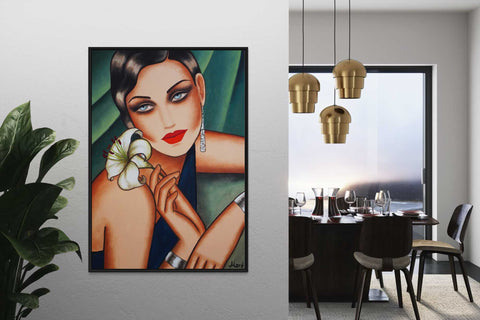
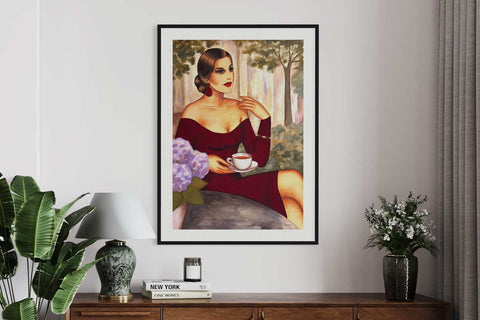
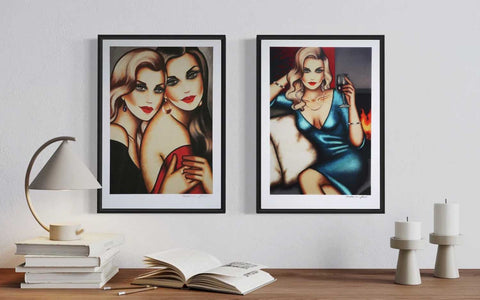
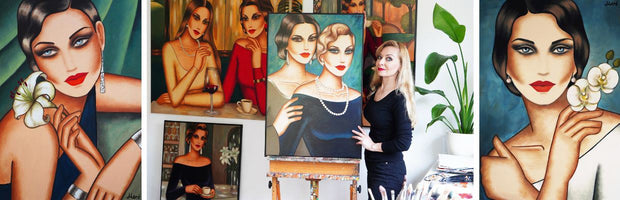
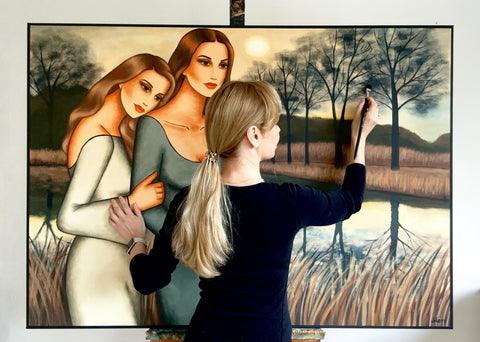
My art became my daily anchor. Every brushstroke, every written word helped me remember my inner strength. My inner garden, which previously seemed so barren and desolate, slowly began to grow again. I immersed myself in the images that arose from within me and gave them space to unfold. The beautiful female figures that appeared were symbols of emotions that I increasingly wanted to invite into my life. Beauty became healing, vitalizing, and exciting again.
These inner images stood in stark contrast to the self-doubt, restlessness, all the negative news, and fears that otherwise surrounded me. People often ask me why I paint beautiful women – the truth is that I receive much more beautiful soul images in my inner visions and try to reproduce their beauty as best as I can.
It wasn't always easy, and the temptation to drift into the fears of the outer world was great. But the more I focused on art, the stronger the light within me became. The process was similar to tending a garden: it requires patience, care, and constant attention. But with each day that I painted or wrote, my inner space grew until it became a blooming garden again.

Your Inner Garden – and How You Can Discover It 🌺
Perhaps you're now asking yourself, "And how do I begin to discover my own inner garden?" The answer is simpler than you might think: in small steps. Your inner garden doesn't have to be perfect, and it won't be in full bloom every day. But it's there, deep inside you. All it needs is a little attention, a little care – and above all, patience.
The first step is to give yourself space. Consciously make time in your everyday life that is just for you. Don't get carried away by the fast pace of the world. Create moments of stillness, reflection, and mindfulness. These times are the water and sunlight for your inner garden.
Surround yourself with things that nourish you: art, nature, music, or simply silence. Ask yourself questions like: "What do I really need to feel good?" or "What inner images appear when I settle down?" Your imagination and creativity are powerful tools that can help you shape your inner space.
And above all: have the courage to get to know yourself better. Your high sensitivity is not a flaw or a deficiency. It is a part of you, and the better you understand it, the stronger you will feel. Imagine what it would be like to fully embrace this inner garden and let it grow.
My video about high sensitivity and the creation of the painting "Demigoddess Psyche and Blue Butterfly" on YouTube:

Final Words: Your Journey Matters
High sensitivity is not a weakness – it's a gift. And yes, sometimes it's hard to accept this gift. It challenges us to feel more deeply, to live more intensely, and to perceive the world in all its facets. But if you learn to embrace it, it will become a source of strength and inspiration.
I hope my story has inspired you to find your own path and to nurture your inner garden. Don't be discouraged by the storms of the world – they are only temporary. The garden within you remains. It is your source of strength, your creativity, and your light.
Perhaps one day you will look back and realize that the darkness you walked through was necessary to bring forth this special bloom within you.
Start discovering your inner garden – I promise you, it's worth it.