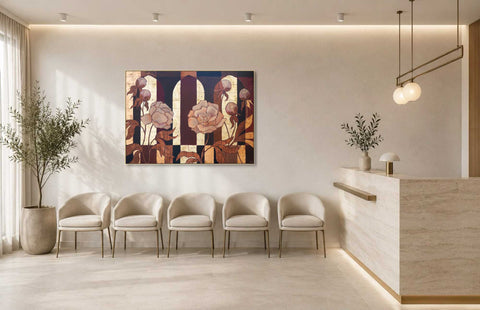
Art for practices and waiting rooms is far more than an aesthetic choice. It influences how people feel, even before the first word is spoken. Especially in a doctor's waiting room, nervousness, tension, and expectation converge. This makes it all the more important to create an atmosphere that inspires trust and calms without appearing cold or arbitrary.
Floral art is particularly well-suited for this purpose. It is not confrontational, does not require explanation, and speaks to people on a deep, unobtrusive level. Colors, shapes, and rhythms have an effect before the mind categorizes them. As an artist, I repeatedly experience how hand-painted originals in practice rooms change something: the mood becomes calmer. The space feels more valuable. And patients feel seen and supported.
In this article, I share my experiences collaborating with doctor's practices – and show why original floral art can be a quiet yet powerful support in daily practice, especially today.
1. Why Art in the Waiting Room is Underestimated
The waiting room is often the first place where patients truly arrive. And at the same time, it is one of the most sensitive. There is time here. Often too much time. Thoughts race. Worries grow louder. Physical discomfort moves into the foreground.
Many practices underestimate how powerful this room is. White walls, interchangeable prints, nice photos, or purely functional design leave people alone with their tension. Yet precisely here, something else could begin: relief. Orientation. A first feeling of trust.
Art can carry this space. Not through distraction, but through atmosphere. A high-quality original signals appreciation. It shows: This place was consciously designed. People care here. Not just medically, but also humanly.
I often receive feedback that patients are touched by my paintings. That they become calmer. That conversations arise. Art here acts not as decoration, but as a mediator. Between space and person. Between tension and a first moment of release.
Especially in hectic times, when practices are heavily burdened, art can take on what words don't have to. It creates a framework. It holds the space. And it thus indirectly supports the healing process.
2. Why Floral Art is Particularly Suitable for Practices
Floral motifs possess a special quality. They are universally understandable. No one feels attacked or excluded by them. And yet they are full of meaning.
Flowers stand for growth, renewal, cycles. For life in all its phases. These are precisely the themes that accompany many patients – consciously or unconsciously. In an abstract, artistic form, floral motifs do not appear banal or decorative, but supportive. They open up spaces without demanding anything.
My work is not about realistic depictions. But about essence. About movement. About the interplay of calm and energy. The works are multi-layered, with glazes, drawings, and structures. They invite viewing. And at the same time, they maintain enough distance not to overwhelm.
Many doctors appreciate exactly that: Floral art acts like a silent meditation object. It calms without boring. It provides support without lecturing. And it allows each viewer their own access.
Especially in a practice environment, this openness is crucial. Art here should not try to explain. It should simply be there. And therein lies its strength.
3. Which Styles Have Proven Successful in Practice Rooms
Not every type of art is suitable for every practice. In my work, it has become clear which styles function particularly well in medical rooms.
Abstract floral art with calm, deep color palettes creates balance. Earthy tones, warm nuances, muted contrasts. Complemented by subtle metallic accents that reflect light without glaring. Gold or metallic surfaces here do not appear luxurious in the classical sense, but rather valuable and calming.
This type of art fits into both modern and classic practice concepts. It does not compete with the furnishings, but connects the elements. Rooms appear more refined, thoughtful, and high-quality.
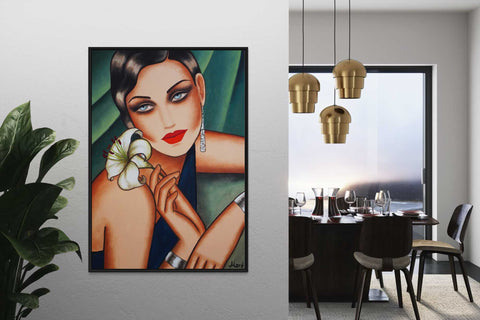
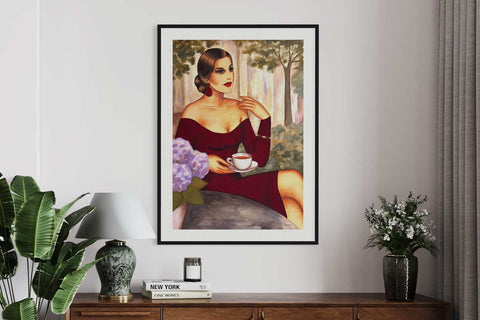
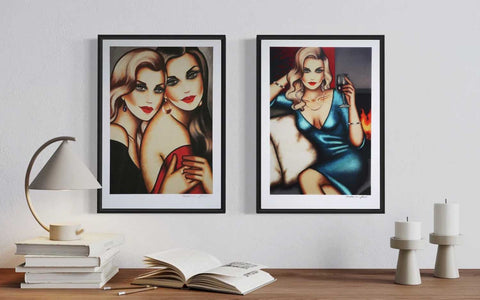
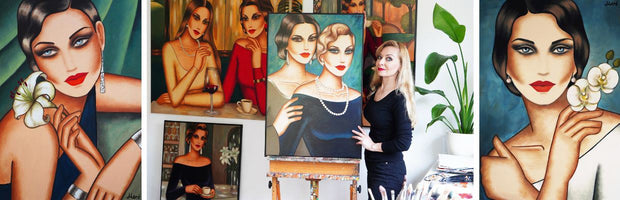
In some practices, I have also integrated female imagery – especially in gynecological or holistically oriented practices. Here, female figures in stylized, dignified representation can create trust and identification. The balance is always important: art should accompany, not dominate.
Which style fits depends on the specialty, room size, and target group. That is precisely why individual consultation is so valuable.
4. Picture Size & Placement in Practice Rooms
The effect of art in practice rooms largely depends on its size and placement. Especially in the waiting room, it determines whether a picture is merely perceived – or whether it truly supports the space.
A common mistake is to think of art as too small. Single, small pictures quickly get lost on large wall surfaces. They appear like decoration, not like a conscious design element. Original floral art particularly unfolds its power when it is given space.
Larger formats or multi-part works have proven very effective. A diptych – a work consisting of two canvases – or compositions of three or four pictures create calm and coherence. Even if there is space between the individual canvases, a common thread emerges. The gaze can wander without getting lost. This is precisely what has a calming effect in the waiting room.
Multi-part works are particularly well suited for long wall surfaces, corridors, or spacious waiting areas. They structure the room without dividing it. At the same time, the design remains flexible: distances can be adjusted, formats varied. This allows art to be adapted very well to existing architecture.
The height also plays a role. Pictures should hang at a height where they can be easily perceived while sitting. Not too high, not too dominant. Art in the waiting room can be present – but it doesn't have to try to impress. Its task is to hold the room together.
I am happy to provide specific advice here. Often, a photo of the room is enough to sensibly assess the format, number of works, and placement. Good art adapts – not the other way around.
5. Commissioned Art & Individual Solutions for Practices
Many practices desire something special. Not an off-the-shelf picture, but art that truly suits the place. This is where the strength of commissioned art begins.
I have already individually furnished several practices – each with its own requirements, rooms, and atmospheres. No project is exactly alike. And that is precisely what makes this work so fulfilling for me.
In a personal conversation, we first clarify what is important: room size, light, specialty, desired effect. Some practices want calm. Others a bit more energy. Some prefer very restrained works, others a central statement.
In commissioned works, content levels can also be incorporated – subtly and abstractly. Medicinal plants. Flowers with symbolic meaning. Growth forms. Cycles. All in an artistic language that does not need to be explained but has an effect. These pictorial worlds can provide patients with support without confronting them.
Technically, many possibilities are also open: multi-part works, special color palettes, metallic accents, calm gold tones, or consciously matte surfaces. The goal is always the same: art that strengthens the space – and not just decorates it.
Commissioned art is not a complicated process. On the contrary. It develops step by step, in dialogue. And in the end, there is a work that belongs exactly there.
If you want to consciously design your practice rooms and are looking for art that conveys atmosphere, trust, and value, I will gladly advise you personally.
👉 Request a non-binding consultation for practice rooms: info@ekaterina-more.com
6. FAQ – Frequently Asked Questions about Art for Practices & Waiting Rooms
Why is art in the waiting room so important?
Because it shapes the first impression. Art can reduce nervousness, build trust, and give the room a human, valuable atmosphere.
What kind of art is particularly suitable for doctor's practices?
Abstract floral original art has a calming, open, and supportive effect. It doesn't require explanation and appeals to people emotionally without overwhelming them.
Are multi-part works useful for practices?
Yes. Diptychs or series of several canvases structure large wall surfaces and have a particularly harmonious effect in waiting rooms and corridors.
Is commissioned art possible for practices?
Yes. I create individual works, tailored to the space, light, and desired effect – including symbolic floral motifs.
Does art in practices need to be very neutral?
No. It should be calm and valuable, but have character. Good art creates connection without being dominant.
What distinguishes original art from prints in practice rooms?
Originals impress with their depth, materiality, and presence. They change with light and space – and convey value that patients perceive intuitively.