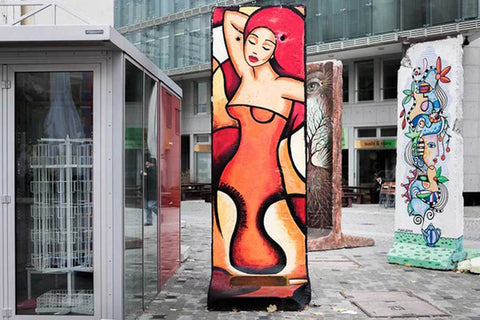
This artwork on a piece of the Berlin Wall is one of my most personal projects. With my painted wall, I wanted to show how femininity in art can be powerful, emotional, and symbolic—right in the public space. Two female figures embody opposites: fire and water. Passion, temperament, and courage on one side—intuition, depth, and devotion on the other.
The art project "Fire & Water" not only connects colors but also history, emotion, and three generations of my family. It was created directly in Berlin—where there was once separation, I wanted to make a statement for connection and feminine energy.
It was a hot summer day in Berlin—the sun beat down on the asphalt, the sky was cloudless, almost surreally clear. Before me stood a rough, gray piece of history: an original section of the Berlin Wall. And yet it was not just a concrete block. It was a canvas. An invitation. A place of transformation.
With me: three generations of my family. My mother held the ladder, my daughter handed me the paints, my sister photographed every step. I balanced on top—between fire and water, brush and heartbeat. Never before had I worked on such a large surface, never before had I been so physically and emotionally challenged.
This project was more than art in public space. It was an act of connection. Between opposites. Between women. Between history and emotion.

1. Fire & Water – Symbolism and Origin of my Art
I am fascinated by contrasts—especially when they don't fight each other but complement each other. That's exactly what I wanted to make visible in my wall project. Two women, two sides, two elements: fire and water.
Fire stands for passion, courage, untamedness. Water for depth, intuition, healing. Both are archetypically feminine forces—seemingly incompatible, yet they belong together. In my work, the two women do not look at each other, they belong to different sides of the wall—and yet their energy flows into each other.
The title "Fire-Water" is deliberately ambiguous. In Russian, "Огненная вода" is a term for high-proof alcohol—an image for something that can intoxicate but also destroy. For me, it was a poetic play on words about life itself: about what burns within us, and what calms us at the same time.
I wanted to imbue the wall—as a symbol of separation—with feminine symbolism. I wanted to show that true harmony is not created through uniformity but through the recognition of opposites. Perhaps that is precisely my artistic mission in life: to build bridges without denying differences. Together instead of either-or. That is my vision of femininity—and of art.

2. Creation of the Artwork "Fire & Water" – In the Heart of Berlin
When I first saw the piece of wall, it took my breath away for a moment. So massive, so raw, so full of history. I had never worked on something so big before—and suddenly I stood with my sketches in front of this surface, in the middle of Berlin's summer sun. The colors glowed in the bucket, I myself was full of adrenaline—and yet I had weak knees. Not only from excitement, but also because of the height.
Luckily, I wasn't alone. Three generations of my family were by my side: my mother Natalia, my sister Anastasia, and my daughter Nina. Together we formed a very special team of artists. My mother held the ladder steady while I balanced above—brush in one hand, paint pot in the other. My daughter handed me rags and brushes, while my sister photographed and motivated. We laughed, doubted, improvised. It was wild—and beautiful.
I painted one side in deep blue tones—flowing, cool, translucent like water. The other side blazed in red tones—vibrant, powerful, almost glowing like fire. Two dancing women on the wall—not mirror images, but equal in value. I wanted to show that these forces don't have to compete. They can coexist if given space. Just as we women often have to learn to do within ourselves.

3. Two Women, Two Elements – The Meaning of Fire & Water
When I look at the painted sides of my wall section, I see two women—and two forces at work within all of us. Fire and water. Two opposites that do not exclude but complement each other. For me, that is precisely femininity in art: an interplay of elements, of impulse and intuition, of courage and devotion.
The red woman—with raised arms, closed eyes, resting within herself yet full of energy—represents fire. She embodies passion, creativity, temperament. Her silhouette is soft but powerful. Her color glows—like the inner fire of a woman who knows what she wants.
The blue woman on the back—flowing, sensual, cool and clear—symbolizes water. She stands for intuition, gentleness, emotional depth. She too has her eyes closed, but she appears different—like someone who lets go, trusts, surrenders to the flow.
I didn't want to show confrontation, no dualism. But connection. In my eyes, true strength lies in the balance of these opposites—not in the victory of one over the other.
These two female paintings are more than just paint on concrete. They tell of the diversity of the feminine—and how emotional art can reconcile opposites without flattening them. It is a dance between heat and depth. Between fire and water.
Want to learn more about my Flowism style?
➤ To the article: "Flowism: Femininity, Joie de Vivre & Modern Art in Flow"

4. Exhibition at Checkpoint Charlie – Art in Public Space
The painted wall was displayed at Checkpoint Charlie in Berlin—a place that, like no other, stands for division, history, and change. It was touching to see my work there in the public space. Amidst the urban hustle and bustle, between tourist groups, locals, art lovers—stood my woman in red, my woman in blue. Two sides, two souls—united on concrete.
Many people stopped, looked twice. Some smiled, others took photos or started conversations. "A wall can be so sensual," one visitor said. That deeply moved me. Because that's exactly what I wanted to show: that art can touch—even without words.
Berlin was the perfect place for this project. Because so many opposites meet here—history and future, East and West, fire and water. And because I believe that art unfolds its true value when it takes place in life—not in an ivory tower, but among people.

5. FAQ – Art Project "Fire & Water" by Ekaterina Moré
What does Ekaterina Moré's wall section "Fire & Water" depict?
The artwork features two sensual female figures—one in fiery red tones, the other in cool blue tones. They symbolically represent the feminine forces of fire and water.
Where was the artwork exhibited?
The painted wall section was publicly presented at the historic Checkpoint Charlie in Berlin.
What is the meaning of the symbolism of fire and water in Ekaterina Moré's art?
Fire stands for passion, courage, and vital energy—water for intuition, depth, and devotion. Both forces are part of feminine identity and harmoniously come together in Moré's art.
Why does Ekaterina Moré combine art with feminine energy?
For Ekaterina Moré, femininity is a powerful source of inspiration—multi-layered, sensual, and emotional. Her art celebrates precisely this energy in form and color.

6. My Conclusion – What the "Fire & Water" Project Stirred in Me
When I look back on this project today, I can still feel the heat of that summer day, the brush in my hand, my mother, my sister, and my daughter by my side—three generations who created something together.
Through this wall section, I learned something about opposites—and about myself. That art can do something important within us. That what separates us can also be what connects us—if we are willing to look.
Becoming visible in public space was a special moment. It was as if my art stepped onto a larger stage—tangible, palpable, right in the midst of life.
I hope my art touches people. That it encourages living oneself in all its facets—fiery, flowing, feminine, true.
If the symbolism, the colors, or my story have moved you, I would be happy to hear from you. Perhaps a new image will arise from your own life story.
Are you looking for a special piece of art for your home? You can find more in my article on Emotional Art for Your Rooms:
➤ To the article: "Women's Portraits for the Living Room – Emotional Art on Canvas"