What happens when care becomes a fetter? When love restricts instead of liberates?
The mother archetype is considered the epitome of warmth, protection, and unconditional devotion. Yet, behind the idealized image of the “good mother” often lies a shadow: control, overprotectiveness, emotional dependence. The maternal ambivalence – between security and boundary transgression – accompanies many women and daughters throughout their lives.
In this article, I delve into the shadow side of the mother archetype, how it manifests in relationships, internal patterns – and in my art. I combine psychological perspectives (C.G. Jung, Jean Shinoda Bolen, mother complex) with my own experience as a daughter, sister, mother, and artist.
And I invite you to ask yourself:
What does it mean to you to be a good mother – or to have had one? Where does your freedom begin, and where does loyalty end?
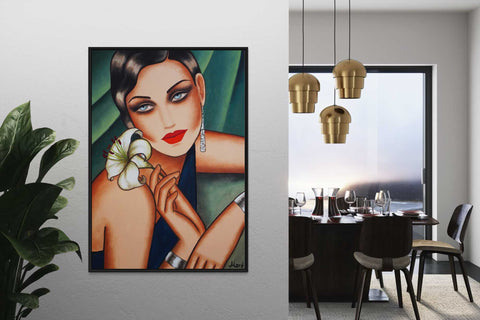
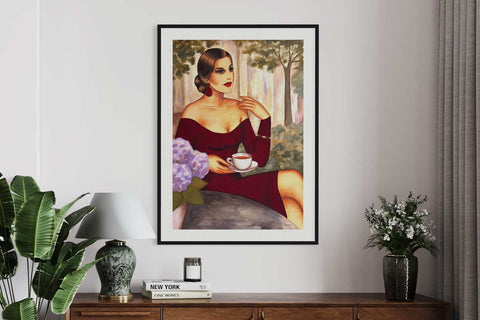
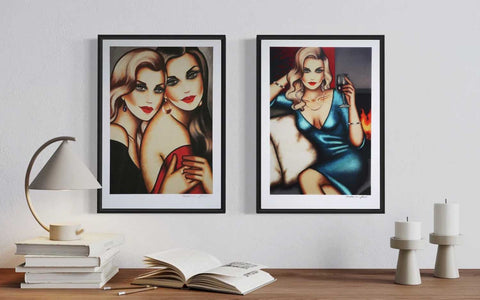
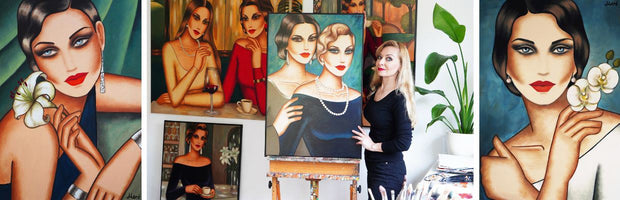
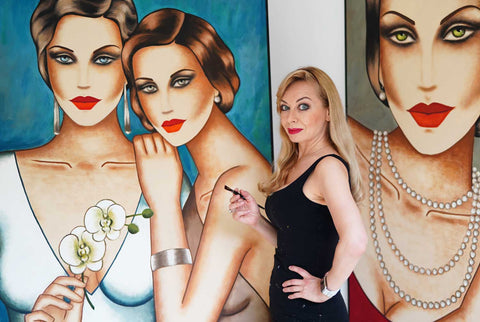
The works from my series Feminine Glamourism show the fine lines between closeness and constraint, love and power – and provide space to make the invisible visible.

1. The Light Sides of the Mother Archetype
The Mother as an archetype represents the primal image of nurturing, protective power in the collective consciousness. She embodies unconditional love, selfless devotion, limitless care. Her energy warms, comforts, heals. In this luminous form, she is the source of life – just as the goddesses Demeter, Mary, or Isis were revered in many cultures as symbols of female creative power.
This maternal energy is also present in my art – for example, in works such as "Goddess Demeter" or "Slumbering Venus", which depict the beauty of receptivity and inner peace. The female figure there becomes a symbol of inner abundance – she nourishes through her mere existence.
In my first article on the psychology of femininity, I extensively presented the powerful side of this archetype – as a path to self-acceptance and healing. But every archetypal force also carries a shadow. And this shadow begins precisely where love turns into control.
➤ More on this in my article "The Mother Within Us – The Archetype and Its Role in Self-Development"

2. Shadow Sides – When Mother Becomes a Threat
As healing as the closeness of a mother figure can be – it becomes equally stifling when it knows no bounds. The dark side of the mother archetype manifests in excessive care, emotional appropriation, subtle blackmail, or feelings of guilt. The good mother becomes the possessive mother who cannot let go – out of fear, unresolved issues, or her own lack.
In mythology, we encounter her in figures like Medea, who kills her children, or the evil stepmother, who poisons her stepdaughter's life. In other cultures, she appears as the black goddess: Kali, who destroys to renew, or Lilith, who refuses all submission.
C. G. Jung described this side as part of the mother complex: an unconscious bond that ties both men and women to childlike dependency. Instead of maturity, regression, guilt, or loss of self develop. The mother becomes an inner superego – loved and feared simultaneously.
In art, it takes courage to show this dark side as well. In some of my works – such as the double portraits in the Feminine Glamourism style – this ambivalence becomes palpable: the gaze is tender and distant at the same time, the closeness intense, but not unambiguous.
For true healing happens not only in the light – but where we confront the shadow.
3. What is the Mother Complex – and How Does It Manifest in Relationships?
The term mother complex comes from C.G. Jung's depth psychology and describes unconscious imprints left by the mother figure, which are later reflected in our relationships. This archetypal mother role often acts more powerfully than we realize – even if we didn't have a close connection to our own mother.
In women, the mother complex can manifest as excessive conformity or rebellion: some idealize the mother or unconsciously strive for her approval, while others reject everything maternal – including care, softness, and receptivity. In both cases, the woman remains inwardly unfree.
In men, the mother complex often appears as a strong attachment to motherly women or as an avoidance of female intimacy. Their choice of partner is often guided by the inner child – in search of security or autonomy.
In psychology, the mother role is understood not only as a relationship figure but as a key to one's own identity. How we love, trust, or set boundaries – all of this is deeply connected to our relationship with our mother.
➤ Note: You can find more about the mother complex in the FAQ at the end of the article.

4. Art as a Mirror of the Mother Role: How Shadows Become Visible
Art offers the freedom to express what often remains hidden in words. In my work, the mother role in psychology is reflected, as is the inner child – vulnerable, searching, ambivalent. Many of my works show women who radiate both closeness and distance simultaneously – as in my double portraits or in the pictures with cats and daughters.
The female shadow sides – power, control, fear of loss – do not push themselves to the foreground here, but flow subtly into the work. An intense gaze, a tense gesture, a symbolic touch can tell more about mother-daughter dynamics than an entire theoretical chapter.
In the artistic engagement with archetypal female images – whether as a nurturing goddess or as a controlling figure – a space for healing emerges. Not because everything is resolved, but because everything is allowed to be.
5. My Path – From the Need for Control to Balance
I know from my own experience how narrow the line between care and over-care can be. As a young mother, I wanted to do everything "right" – be present, comfort, protect, encourage. But at some point, I realized: I wasn't breathing anymore. I had become a kind of "helicopter mother" who lost herself trying to be there for everyone.
Especially in my relationship with my daughter, I felt how my good intentions sometimes turned into suffocating closeness. I put my own needs aside, but that didn't make me more generous – it made me feel emptier inside. I tried to be a good mother for everyone: for my daughter, my sister, even for my mother. In the end, I wasn't for anyone – and certainly not for myself.
Art became my way to detach myself. On the canvas, I could begin to observe myself – without judgment. I began to paint women who were not only nurturing but also independent, proud, vulnerable, or unattainable. This is how I found balance: between closeness and autonomy, between affection and self-respect.
Every picture became a mirror. And slowly I understood: The best mother is not the perfect one – but the authentic one. The one who loves, lets go, and stays true to herself.

6. The Shadow in Art – Why I Show the Dark
In my art, it's not just about beauty in the classical sense – but about the truth of femininity. And this truth is complex. It's not always bright. It knows doubt, contradiction, control, power. To make precisely these shadow sides visible is essential for me.
Because true wholeness arises only through contrast. Light only works when it meets darkness. Female energy unfolds its depth only where it is also allowed to be vulnerable, challenging, mysterious. That's why in many of my works, I show women with intense, sometimes unfathomable gazes – as in "Together", "Closeness", or the work "Autumn Afternoon by the Lake". The women are close together, but not entirely merged. You sense: A whole universe lies between devotion and distance.
My femme fatale paintings also carry this ambivalence. Seduction there is not a submissive gesture – but an expression of power, control, self-determination. The cat in the painting "Love is…" symbolizes holding on – and the fear of losing something you love.
This art is my space for shadow integration. I invite you to look – even where it hurts. Because only when we see ourselves in light and darkness do we become whole.
More about Femme Fatale Archetype:
➤ Article "The Femme Fatale: An Archetype in Art"
➤ Article "Forget Nice, Be Dangerous: How Much Femme Fatale is Really in You?"
7. The Integration of the Shadow – Self-Empowerment
The mother archetype manifests in every woman – whether with children of her own or not. But only when we acknowledge both light and shadow does a mature maternal energy emerge. One that is not sacrificial or engrossing, but clear, loving, and at the same time independent.
It took me a long time to allow myself to say: "I can be a mother – but also remain myself." Today I know: I can set boundaries, withdraw, say no – without loving less. True motherhood does not mean losing oneself, but being rooted in oneself and nourishing from that depth.
Art is my way of making this reconciliation visible. In my female portraits, I bring out the ambivalence – as an invitation to inner balance. My female figures are allowed to be contradictory: tender and distant, devoted and autonomous, warm-hearted and proud. In this complexity lies our strength.
When we begin to integrate our shadows, self-empowerment arises. Then we no longer have to be perfect mothers, daughters, or women – but are simply allowed to be ourselves. And that's where healing begins.
Conclusion: The Two Faces of the Mother – A Mirror for Ourselves
The archetype of the mother is a powerful mirror. It shows us not only love and care, but also control, overwhelm, and old wounds. But in this complexity lies its opportunity: If we learn to see both sides – the light and the shadow – we open ourselves to a deeper self-knowledge.
My art invites you to recognize yourself in this ambivalence. Perhaps you recognize yourself in one of my works – in a woman who loves and lets go, who is strong and gentle at the same time. Let yourself be inspired to find your inner balance – and to write your own story.
If you don't yet know the nurturing side of the mother archetype, also read my article:
➤ Psychology of Femininity – The Art of Being a Woman
FAQ – Frequently Asked Questions about the Mother Archetype
What is the shadow side of the Mother Archetype?
The shadow side manifests in excessive care, control, appropriation, or emotional blackmail. It can hinder a child's development and lead to inner dependency.
How does a mother complex manifest according to C.G. Jung?
A mother complex can manifest in excessive conformity, dependence, or even rebellion and rejection of female authorities. It often arises from unresolved dynamics in the mother-child relationship.
How does a mother complex manifest in men?
In men, the mother complex often manifests in the idealization or rejection of female figures. Some unconsciously seek "substitute mothers" in relationships, others reject everything feminine or feel permanently unfree. Both can hinder bonding and self-development.
What is a mother complex in women?
A mother complex in women often manifests as an inner conflict with their own femininity. In the positive mother complex, one idealizes the mother and feels strongly drawn to maternal roles or women. In the negative mother complex, one rejects the mother – and everything maternal. Both poles can create both blockages and a drive for development.
Why is it important to understand the dark side of the mother as well?
Only when we acknowledge both sides – light and shadow – can we heal our relationship with our mother and fully accept ourselves. This creates space for self-empowerment and inner maturity.