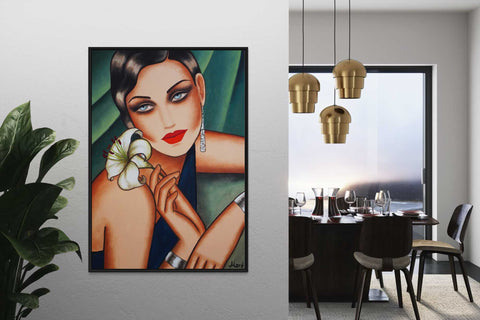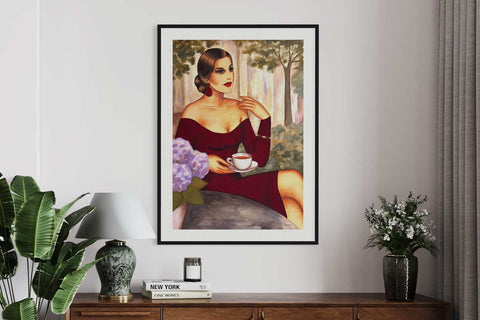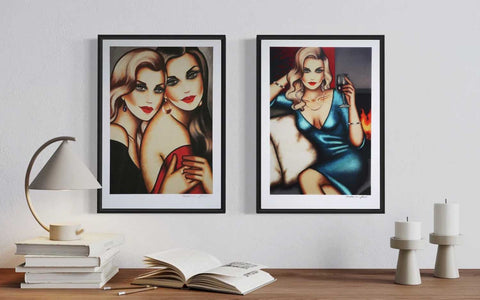
I am always looking for inspiration and new influences that can enrich my work. One movement that has long fascinated and inspired me is the Pre-Raphaelites. This group of artists, active in England in the 19th century, brought a breath of fresh air into the art world and sparked a revolution that still resonates today.
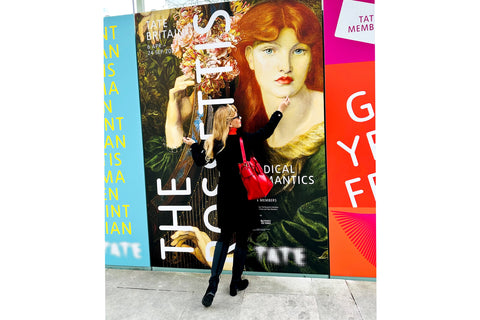
Recently, I was lucky enough to see some significant Pre-Raphaelite artists at the Tate Britain in London. The collection presented some of the most important works of this movement and gave me the opportunity to be inspired by the artists I admire so much.

Dante Gabriel Rossetti is one of my favorite artists, as I find his works incredibly aesthetic and poetic. He was one of the founding members of the Pre-Raphaelite Brotherhood and one of the most important artistic voices of his time. Rossetti was born in London in 1828 and grew up in a family of scholars and artists. He showed great interest in art from an early age and began his training at the Royal Academy at 14.
The Pre-Raphaelite artists, including Rossetti, wanted to distance themselves from the then-dominant academic art and establish a new, independent art movement. They drew inspiration from medieval and Renaissance art before classicism and romanticism entered the art world. Rossetti was known for his vibrant and colorful paintings, in which he expressed his musical and literary interests.

The exhibited works "Sancta Lilias" and "Rosa Triplex" are typical of Rossetti's style and show his fondness for depicting women in an idealized, almost mythical form. "Sancta Lilias" shows a young woman holding a lily. The figure appears almost supernatural and has something of a sacred figure.

John Everett Millais was another founding member of the Pre-Raphaelite Brotherhood and one of the most famous painters of his time. He was born in Southampton in 1829 and began studying art at the age of nine. He later attended the Royal Academy of Arts and worked as a professional artist from a young age.
Millais was one of the most renowned artists of the Pre-Raphaelite movement and was known for his realistic depictions and detailed compositions. His paintings were often inspired by literary or historical themes and exuded a deep melancholy.
The exhibited work "Ophelia" is one of his most famous works and depicts the famous scene from Shakespeare's "Hamlet" where Ophelia drowns in a stream. Millais depicted the scene in a realistic, almost photorealistic manner, paying close attention to the details of the gown and the floral wreath. The work is an example of the Pre-Raphaelite style and demonstrates the artists' love for detail and nature.

Edward Coley Burne-Jones was an English painter and designer and a leading member of the Pre-Raphaelite movement. He was born in Birmingham in 1833 and initially studied theology before turning to art and working at Oxford University. There he met William Morris, with whom he maintained a close friendship and collaboration.
Burne-Jones was known for his mythological and literary themes, which he depicted in a romantic and decorative style. His paintings were often inspired by ancient legends and medieval stories, and he also created many illustrations for books and other artworks.
One of his most famous works, "Frieze of Eight Women," was shown at the Tate Britain exhibition. The painting is a depiction of eight women sitting on a wall or balcony, looking in different directions. Each woman is individually designed, with different clothes, hairstyles, and postures. The painting is an example of Burne-Jones' ability to create decorative compositions while conveying a deeper meaning. The women represent different emotions and moods and stand for the diversity and complexity of the female being.

John William Waterhouse was an English painter who lived from 1849 to 1917. He was a member of the Neo-Pre-Raphaelite movement, which later split from the original Pre-Raphaelite group. Waterhouse was known for his depictions of mythological and literary themes, especially female figures.
One of his most famous works, "The Lady of Shalott," was also on display at the Tate Britain exhibition. The painting shows the titular figure drifting in a boat on a river. She holds a lyre in her hand and stares blankly at the water. The scene is painted in warm, rich colors, and the light creates a mysterious and fairytale atmosphere.
"The Lady of Shalott" is based on a poem by Alfred Lord Tennyson, which tells of a woman imprisoned in a tower and cursed to die if she looks directly at the outside world. By using a mirror, she can observe life outside the tower. One day, the Lady of Shalott sees the knight Lancelot in the mirror and falls in love with him. In a moment of weakness, she looks out the window to see him directly, which fulfills the curse and breaks the mirror.
She then decides to travel to Camelot in a boat to find her beloved knight. However, her strength wanes more and more during her journey, and as she leaves the island, she eventually dies, singing a final song. She writes her name on the bow of the boat.
Waterhouse perfectly captures the atmosphere and emotions of the poem, giving the figure incomparable grace and beauty. The work demonstrates the artist's love for detail and his ability to create a poetic and mysterious atmosphere that transports the viewer to another world.
As an artist, I am deeply fascinated by the beautiful depictions of women by the Pre-Raphaelites. It is astonishing how they express the divine power of femininity so poetically and gracefully. Every brushstroke and every detail of their works conveys a deep emotional meaning that transports viewers to another world. It is also remarkable how the Pre-Raphaelites depict the mystical and mysterious inherent in women in such a picturesque way. Their art is a beautiful tribute to the beauty, strength, and grace of women and will continue to be an endless inspiration for artists and art lovers worldwide.