When was the last time you were alone – and truly felt comfortable?
Our society constantly shows us images of communal happiness – laughing groups, celebrations, travels, perfect zest for life in glossy magazines. In advertisements, TV series, and social media, true life always seems to be happening somewhere out there – and ideally: together. Those who don't belong, who are alone, quickly feel excluded. Not because they are wrong – but because their experience doesn't fit the common picture of happiness.
Many people feel exactly this: a subtle distance from it all. They sense that they feel differently. Deeper, perhaps. Quietly. And that they are not looking for hyped-up entertainment – but for genuine closeness, especially to themselves. Because silence can sometimes be more honest than any smile on social media.
I celebrate precisely this other side of life: the beauty of solitude. The quiet dignity of being close to oneself. And the strength that emerges when you give yourself space.
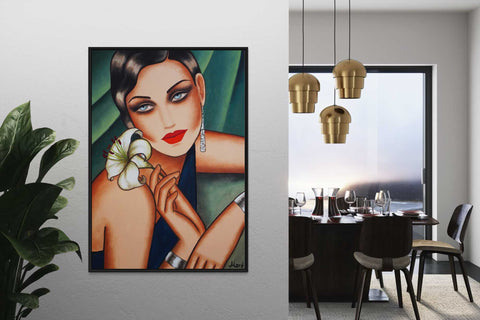
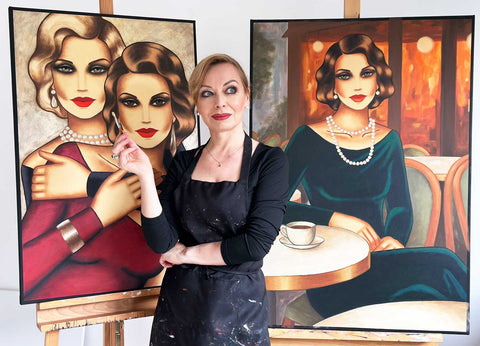
Feminine Glamourism is my artistic expression of this attitude. A style that shows women – not in action, but in grace. Not in turmoil, but in retreat. And therein lies its power: loneliness is not a deficit, but a space.
A space for beauty, emotion, and quiet strength.
A space for you.

1. Solitude as a spiritual space – Melancholy with dignity
Not all loneliness hurts. There is one that is quiet, clear, and somehow beautiful. A loneliness that doesn't feel empty – but expansive. Like a silent space within you where you rediscover yourself.
Psychologically, we distinguish between painful loneliness, which separates, unsettles, hurts – and healing loneliness, which connects: with your depth, your intuition, your inner rhythm.
Women, in particular, often carry this state within them. As melancholy, as a quiet longing, as a need for retreat. It is not a sign of weakness. It is a spiritual state – deep, delicate, dignified.
Perhaps you know that moment,
when the world falls silent... and you suddenly hear yourself.
Thoughts become clear. The heart softens. You are not lonely – you are simply with yourself.
In my art, I try to make this very space visible. The woman on the canvas does not look helpless – she rests within herself. Her solitude is not loss, but source. Her melancholy is not a shadow, but a quiet light.
Feminine Glamourism is an homage to this quiet strength.
To all those women who have learned that retreat is not a step backward – but self-respect. And that it's okay to be in a space with oneself... and to fully feel oneself in it.

2. Why solitude reveals feminine depth
There is a special power in feminine solitude. A quiet, archaic power that is deeply rooted within us – yet often overlooked in today's world. In many spiritual traditions, the woman alone is not on the periphery – but at the center: as priestess, sage, guardian of the inner self. Her strength lies not in the external, but in her depth.
When we are alone, we hear more clearly. We feel more intensely. We think more freely. Solitude becomes a space of intuition, healing, creativity. Many great impulses arise in moments of silence – not in noise. And perhaps you feel it yourself: some of your most powerful thoughts did not come to you amidst people, but on a walk, with tea by the window, or in the quiet of an early morning.
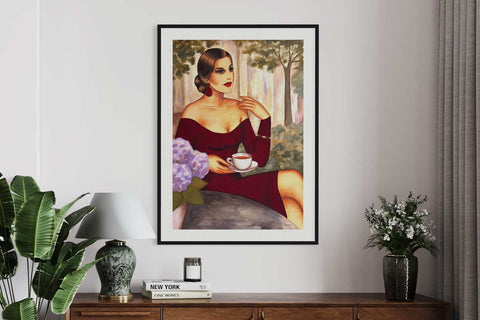
This form of feminine self-connection also manifests in everyday life: when you treat yourself with mindfulness. When you set the table beautifully for yourself. When you stylishly serve yourself coffee. When you arrange flowers just because it brings you joy. These are not trivial rituals – they are acts of appreciation. A quiet: I am worth it.
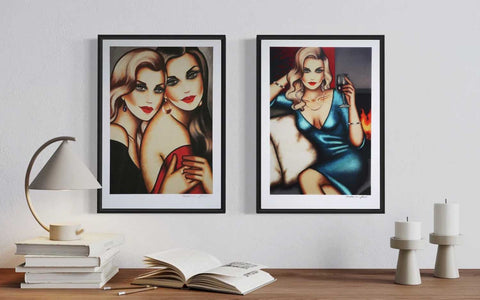
Feminine Glamourism celebrates precisely this attitude. The images show women who do not appear "lonely" – but at peace with themselves. They embody the strength not to flee from solitude, but to arrive within it.
Because true empowerment does not mean avoiding loneliness – but transforming it.

3. Style as emotional self-embrace – Rooms with a soul
Some rooms are more than just functional places. They feel like a deep exhale. Like a "yes" to oneself.
Feminine Glamourism was created for exactly such spaces – places where silence is not empty, but vibrant. Where a single picture tells stories: of longing, style, and inner dignity.
Especially women who carry a lot – responsibility, emotions, thoughts – feel a longing for a place that nourishes them. But the inner conflict is familiar: only when everything is done, may it be beautiful. Only when the external is perfect, may the internal breathe. But what if a work of art can be precisely this first loving impulse?
A feminine portrait in the living room reminds you every day: I am allowed to feel. I am allowed to dream. I am allowed to simply be.
And as you turn to the picture, the space around you expands – to imaginary cafés with delicate porcelain, to fragrant summer gardens, to quiet landscapes by the water. Places that are good for the soul. And amidst these backdrops: the woman – as a symbol of your own depth. Her quiet strength. Her silent beauty.
My works do not create loud statements. They open spaces – for regeneration, for inner connection, for quiet elegance.
They transform the home into a source of strength. Not decorated with mass-produced goods, but filled with genuine, tangible art.
Feminine Glamourism is a quiet invitation: Create a space for yourself that touches you. Every single day.

4. High Sensitivity & Delicacy as a Treasure
Perhaps you know this feeling: You enter a room – and in seconds you sense whether it is good for you. Whether you can breathe. Whether you are welcome. Not because everything is perfectly arranged. But because something resonates. A mood, a feeling that lies between things.
This is how sensitive, highly sensitive people feel. They sense atmospheres, nuances, subtle tones. Their perception is like a fine instrument – sensitive to light, color, sound, expression. To authenticity.
Yet, precisely this delicate way of feeling can feel like a disadvantage in today's world. Those who reflect a lot, go deep, and seek genuine connection often feel lonely. Small talk is exhausting. Superficial encounters leave a feeling of emptiness. And the desire to simply be – without a mask, without a function – often remains unfulfilled.
With my art, I want to address exactly this point: Sensitivity is not a weakness. It is a quiet strength. A gift.
The female figures in the style of Feminine Glamourism show this strength not loudly – but gracefully, softly, alertly. Their gazes wander into the open. Their posture is quiet – but present. They do not say: "Be stronger!" – but: "You are allowed to feel. You are allowed to be delicate. You are allowed to be yourself."
My paintings are resonance spaces for people who feel deeply. They reflect inner worlds without having to explain them. And sometimes, when a highly sensitive woman stands in front of one of these paintings, I hear the phrase:
"I see myself in this picture. Just as I am."
Perhaps that is precisely the task of this art: to remind you that you are exactly right – with your depth, your perception, your quiet strength.
Learn more about high sensitivity:
➤ To my YouTube video about High Sensitivity

FAQ – Feminine Glamourism & Female Self-Connection
What is Feminine Glamourism?
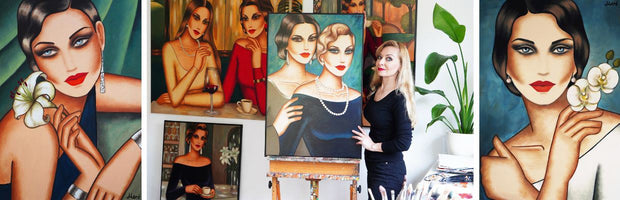
Feminine Glamourism is an art style developed by Ekaterina Moré that showcases the female soul in quiet, sensual moments. Inspired by Art Deco, it combines elegance, emotion, and emotional depth. It's not about posing – but about presence.
How does the style differ from Flowism?
While Flowism stands for joie de vivre, color, and movement, Feminine Glamourism emphasizes the power of silence, melancholy, and self-care. Both styles complement each other – like day and night. Flowism invigorates. Feminine Glamourism touches.
How does art help highly sensitive people?
Highly sensitive people feel more – and often feel misunderstood. Emotional art creates spaces where they feel recognized. The motifs, colors, and forms of expression act as mirrors for their own depth.
Which motifs are suitable for retreat and self-care?
Images of women in cafés, on quiet shores, or in dreamy gardens invite introspection. They do not show loneliness as a lack – but as a gift: for reflection, healing, inner richness.
What makes feminine solitude dignified?
It is not the setting – but the aura. The women in Ekaterina's paintings do not appear lost, but connected. With themselves. With the moment. They are at peace with themselves – and that is what makes them strong.
Conclusion & Invitation
Perhaps your solitude is not a lack at all –
but a call from your soul for beauty.
For retreat. For the gentle power to encounter yourself.
Feminine Glamourism celebrates precisely these quiet moments.
Moments in which you feel:
I am allowed to be soft. I am allowed to dream. I am allowed to be completely myself.
Discover in the gallery female portraits that lovingly accompany you –
like silent companions on the path to yourself.
👉 To the gallery of Feminine Glamourism works
Discover more blog articles:
➤ Article "Overcoming Loneliness with Emotional Art – Experiencing More Life Flow through Flowism"
➤ Article "Feminine Art Deco Pictures – Buy Art with Soul"