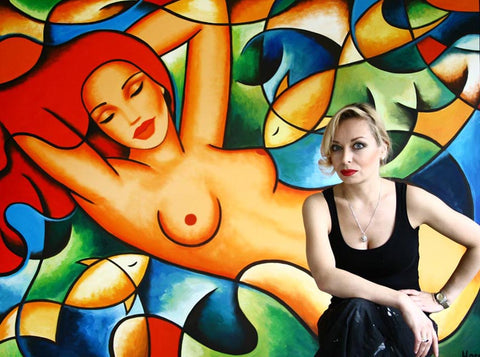
An article about the work of Ekaterina Moré by Dr. Orpel, art historian
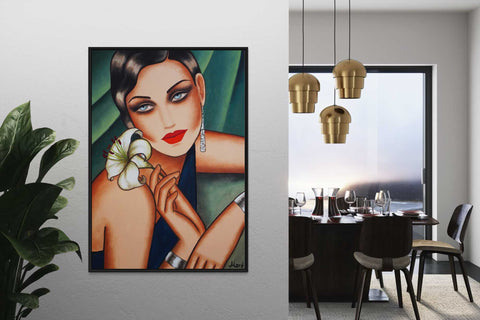
The paintings of Ekaterina Moré are not illustrations or portraits in the conventional sense. They are rather symbolic images, born from deep emotions. With her impressive depictions, the artist expresses her profound respect for female power. It is no coincidence that the deities of ancient times were female, and even in our era, women embody many qualities that the artist harmoniously brings together in her works. The coming century will be feminine or it will not be. The isolated male side, the cold pursuit of power, and the brutal violence often associated with patriarchy have reached their limits. A new age is beginning.
With the figure of the woman – erotic, sensitive, yet powerful and self-confident – the artist sets positive accents in this direction.
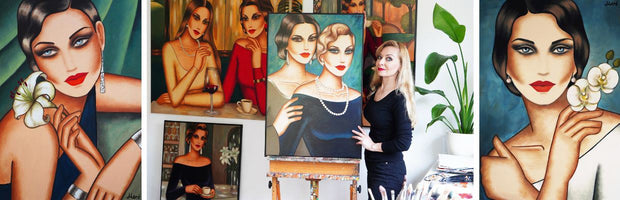
Ekaterina Moré was born in 1976 in what was then Leningrad, which in the early 1990s regained its original name, St. Petersburg. Today she lives in the Rhineland. Her artistic talent was particularly encouraged by her parents, as fine art was highly respected in the family. Her great-grandfather had already studied at the Baron Stieglitz Academy of Design, which was closed during the revolution. Her grandfather attended the St. Petersburg Art Academy. Her father, balancing his officer's career, worked as a sculptor and, together with her mother, who worked as an independent artist, designed stage sets for the local theater.
Such early contact with fine art awakened Ekaterina Moré's interest in painting and drawing in a very special way. Even at a young age, she showed professional tendencies. In her early work, she developed an impressive synthesis between traditional Russian painting and avant-garde art. Although she never received a formal academic art education, she quickly found a very individual painterly expression and successfully established herself as an artist in the West.
With her strong interest in Western art, she was not an exception among Russian artists. The gaze towards the West was characteristic of the Russian artistic avant-garde of earlier times and is documented not least in the rich art collections, especially in Ekaterina Moré's hometown, St. Petersburg. She became familiar with Western European painting during numerous visits to the Hermitage. Post-impressionist painters like Gauguin, Cézanne, and van Gogh were her first artistic role models. Later, Tamara de Lempicka, the famous Polish painter who lived in Paris for many years and from there moved to the USA and later to Mexico, joined them. There are several commonalities between Tamara de Lempicka and Ekaterina Moré. The artistic development of both women, which increasingly led to the depiction of a self-confident and at the same time erotically feminine central figure, is to be mentioned here, as is the fact that Tamara de Lempicka spent some happy years in St. Petersburg, Ekaterina Moré's birthplace, until the October Revolution.
Through her parents' professions, Ekaterina also came to know the vastness of the Russian landscape and the diversity of its regions. She grew up on the Russian-American frontier, on the Kamchatka Peninsula and by the Sea of Japan. The visual experiences there expanded her artistic horizons in a very special way. The Kamchatka Peninsula is vividly described by Ekaterina Moré in her memories of that time. The world of the Chukchi and Koryaks living there, with their colorful costumes, shamanic traditions, and special ritual dances, left a lasting impression.
This deserted area in the far northeast of Russia is the exact opposite of the world of salons and tête-à-têtes that Ekaterina Moré paints today, but perhaps her sensitivity to special light and color effects comes from the color experiences in this region, which lies in darkness in winter and, precisely for that reason, affects the senses so intensely with its exploding colors during the extremely short summer.
Just as that intense northern light sharpened Ekaterina's perception, the solitude and vastness of the subarctic region may have been the impetus for her intense engagement with inner images. She discovered in art the universal language of humanity that connects different cultures and gives people the opportunity to meet their inner child.
Thus, in the Russian Far East, good conditions developed for continuing the chosen artistic path in Germany.
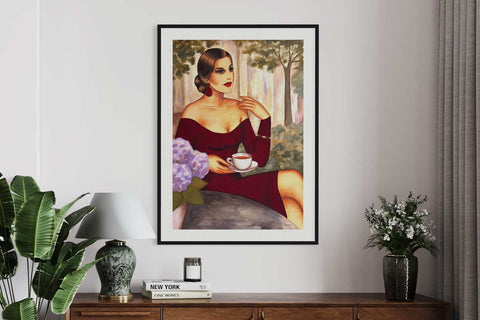
After moving to Germany, she began to paint large-format pictures that quickly attracted the interest of art collectors and gallery owners. The artist had her first exhibition successes as early as 2001. Soon after, her paintings were seen not only in Düsseldorf and other German cities but also in Moscow, Oslo, and Paris. Product designers recognized the potential and expressive power of her figures and transferred Ekaterina's motifs to high-quality luxury items, such as Rosenthal's valuable porcelain dinnerware. Interior designers also became aware of the artist's appealing and tension-filled motifs and brought them to life in very special places. Where could such salon scenes be more fitting than in actual salons, such as in the bar of the Maritim Hotel in Berlin?
The beauty of Ekaterina Moré's female figures comes from within. This makes them appear soulful and alive. These beings radiate self-confidence and integrity – qualities that have a pleasant effect on the viewer.
The attributes worn by the figures bring the type of depiction close to images of saints. As with icons, a kind of symbolic image is created here, which in this case is embedded not in a religious but in a secular context.
Her primary concern is to bring together the multifaceted layers of a personality into an organic unity. This unity consists of the interplay of seemingly contradictory impressions. This is not just about cold rationality and warm-hearted emotions. Ekaterina Moré goes far beyond this in depicting the complexity of human existence and reveals deep nuances. Ekaterina's female figures appear proud and self-confident, yet at the same time compassionate and maternal. They seem open and unapproachable at once, sisterly familiar yet strangely foreign. From all these facets, the artist develops the ideal image of woman, which we can encounter on the same level as masterful icons, which also deal with ideal images that combine contradictory character traits – supposedly good as well as allegedly bad.
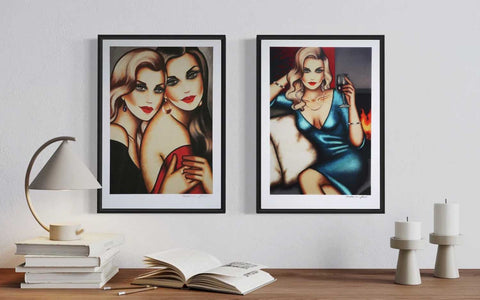
The painting style of such pictures cannot be classically realistic. The artist creates an art world that is totally different from the real world – a theatrum mundi in its purest form, which the viewer can enjoy. In it, she holds her figures in a state of suspension between an elegant outer appearance and an introverted essence. This tension between the inner and outer world gives the paintings a special radiance. Through this indefinable complexity, the scenes are additionally charged with tension. The double portraits, in particular, are especially successful for the artist.
The protagonists move here on an equal footing: a similar elegance and a personal charisma, whose nuanced nature is expressed here with particular sensitivity, shows the range of the palette available to the artist to reveal shades of personality. Only a small, almost invisible intimate touch emphasizes the familiarity between the two protagonists. The viewer's imagination is thus set in motion by an irresistible force. Who doesn't long for such unlimited familiarity and closeness?
Due to their inwardly harmonious polyphony, the female beings to whom Ekaterina Moré pays tribute in her work radiate a special personal strength that is sometimes unsettling. They seem removed from the hardships of the everyday world and to exist only for themselves. They are thus, in the literal sense, autonomous and combine knowledge and dignity. The costume, the jewelry, and even the environment of the respective central figure – the attributes of womanhood – absorb the radiance of the central figures and form the colorful complement to the well-formed female bodies that are at the center of the artistic representation.
Similar to Renaissance painting, Ekaterina Moré is concerned not only with the light effect of colors but also with the materiality, which she brings to life with colorful brilliance. Through her great craftsmanship, the artist shows us an essential kinship with artistic role models that initially seems to lie apart due to the freedom of their depictions. Are the depicted figures modern-day images of saints, very modern, secular successors to classical icon figures?
Similar to Renaissance painting, which is also charged with subtle eroticism, Ekaterina Moré's works certainly allow such conjectures.
Dr. Orpel, Art Historian
This article might also be of interest: My Journey as an Artist: A Path of Self-Discovery and Creativity.