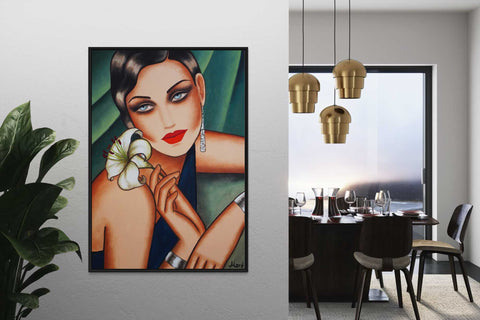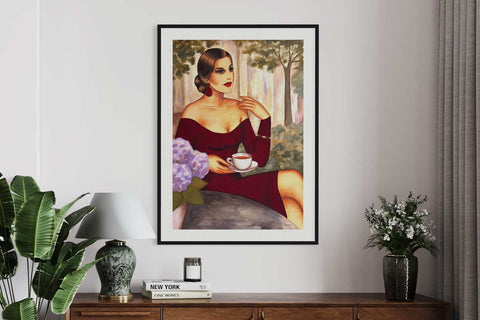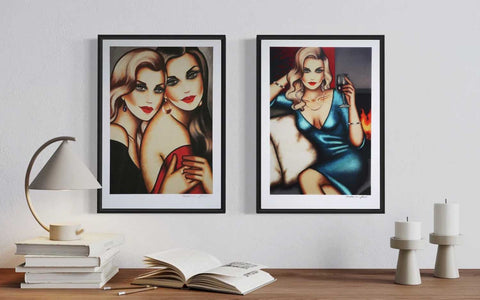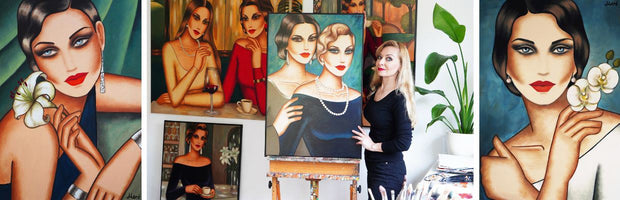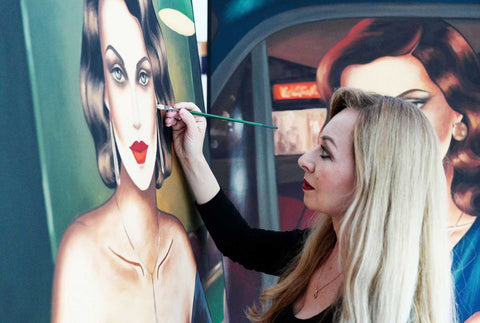
A client wanted to give his wife a very personal painting for her birthday.
The basic idea was there: she was to be depicted together with her little dachshund. But what exactly should this portrait look like? Which colors would really suit her? What mood?
He didn't know precisely himself. So, a small, rather charming detective work began.
In the weeks leading up to her birthday, he would casually ask his wife about colors. Which clothes did she particularly like to wear? Which shades did she prefer? What jewelry did she like? He gradually collected small clues without revealing what he needed them for.
From these conversations, his observations, photos, and my own ideas, the painting finally developed. Only when his wife received the finished portrait did she understand why her husband had suddenly been so interested in her favorite colors recently. She laughed at his little "detective work" – and was delighted with the painting.
I often think of this story when someone asks me about commissioned art. Because it shows quite well what interests me about it: A finished idea is not always present at the beginning. The actual image concept often only emerges during the conversation.
For me, however, commissioned art goes far beyond a personal portrait. Over the past 25 years, I have developed individual paintings for private individuals, hotels, restaurants, and doctor's offices – portraits of women, floral works, series of paintings, and works with symbolic meaning. Each project began differently and was intended to become something unique in the end, without losing my artistic signature.
Often, a commission begins very simply: with a photo, a memory, a favorite flower, a specific room, or simply with the feeling that one of my works is going in the right direction. From this, a concrete idea gradually develops through exchange.
We talk about colors, formats, motifs, and what is truly important. I make sketches, discard some, and develop others further. The finished painting is not yet fixed at the beginning.
For me, that is precisely the appeal.

1. What does commissioned art mean to me?
A commissioned painting is an original created for a specific person, occasion, or space.
Nevertheless, I do not understand commissioned art as a free configuration.
It is not about selecting format, color, and motif from a list and assembling a painting from them.
Of course, all these things can play a role. But for me, they are the starting point of an artistic process, not its finished instructions.
The most beautiful commissioned works arise where the client's vision and my own artistic language meet.
Perhaps someone brings a photo.
Or mentions a specific flower.
Perhaps there is a room with an unusual wall for which nothing has worked correctly so far.
Perhaps a client likes one of my works very much, but wishes for a different size or a slightly different color scheme.
Or someone just knows: This painting should have something to do with a specific person or memory.
I first listen to what lies behind this wish.
What is truly important?
Which details are absolutely essential?
And what can perhaps be developed more freely?
Then my actual work begins: building a bridge between the client's ideas and my own.
A commission should ultimately be personal.
But it should still look like a work of mine.
Precisely this balance is crucial.
If you would like to commission an individual work, you will find more information on the process and how to inquire on my Commissioned Works page.

2. You don't need to know what the finished painting should look like yet
Many people hesitate to commission a work because they believe they need to have a very precise idea already.
That is not necessary at all.
Sometimes someone comes to me because they are drawn to a particular painting of mine. Perhaps it's the color scheme, perhaps the posture of a woman, perhaps a floral work, or just a certain feeling that the work evokes.
Nothing more is needed initially.
An idea can develop in conversation.
For a personal female portrait, photos can be a starting point. Perhaps there is a specific dress, a piece of jewelry, or a memory that is important.
For a floral work, it might be a favorite flower or a color scheme that belongs to a room.
In an interior project, the architecture itself can be the starting point: a long wall, a specific sightline, or the desire for multiple paintings that are connected.
I often find this open beginning even more interesting than a completely finished plan.
Because then there is room for something that no one has seen before.
During the conversation, I often notice what things are really important to a client and which were mentioned rather by chance. This leads to initial directions.
Sometimes I make sketches.
Sometimes we look at previous works together.
Sometimes only a room photo shows which format would even make sense.
And sometimes the best idea only emerges after a few days, when a conversation is still lingering.
Commissioned art is therefore not a quick ordering process for me.
It is more of a collaborative approach to an image that does not yet exist.
You can learn more about my figurative imagery and the special effect of female portraits in a room in my article on Feminine Glamourism.

3. What can be individually developed in a commissioned painting?
A commission can begin very differently. Therefore, there is no single fixed form.
Some things we can discuss very concretely.
Format and Size
The format is often one of the first points.
A painting can be created for a specific wall or planned independently of a room.
Especially for larger works, proportion is important. Sometimes an unusually narrow or wide format works better than a classic canvas size.
Series are also possible if several works are meant to belong together.
Color Scheme
Colors can also be part of the coordination.
It's not about adopting an exact color code or making a painting fit a sofa as closely as possible.
More interesting is the question of what atmosphere should be created.
Should the work appear warm or cool?
Luminous or more restrained?
Does the room need contrast or rather connection?
Sometimes a few hints are enough to develop a color scheme that feels very personal.
Motif
The motif can also be individual.
For female portraits, a specific person based on photos can be the starting point. However, a symbolic image of a woman can also be created.
For floral works, a specific flower can play a role.
Sometimes there are other symbols or details associated with a person, a memory, or a place.
Not every idea automatically suits my work.
I first let a wish sink in and consider whether I can credibly translate it into my own artistic language.
If so, something very unique can emerge from it.
Mood and Effect
Often, the desired mood is even more important than individual details.
A painting can appear calm or very present.
It can be elegant, sensual, powerful, light, or almost meditative.
Such terms are, of course, not mathematically precise.
But they help to find a direction.
Single work or series
Especially for rooms and professional projects, a small series can also be useful.
The paintings don't have to look the same.
Often, a common color scheme, a similar visual language, or a motif that develops in different variations is enough.
This creates a connection without the works appearing like a set.

4. A portrait from photos – but not a copy of the photo
For personal female portraits, I often work with photographs.
A photo is a basis for me, but not the finished painting.
I am not interested in reproducing every detail as accurately as possible.
A good photo can tell me a lot about posture, expression, and personality. But a painting has other possibilities.
Perhaps a dress is simplified.
Perhaps the color scheme changes.
Perhaps a piece of jewelry suddenly plays a more important role.
Or I combine different photos because the posture is beautiful in one and the facial expression fits better in another.
Sometimes the background is also completely redeveloped.
Precisely this creates not a painted photograph, but an artistic interpretation.
This is particularly important when a portrait is created as a gift.
The person should, of course, recognize themselves.
But at the same time, the painting can be more than an accurate reproduction.
It can emphasize a specific side of this woman.
Her elegance.
Her strength.
Something playful.
Perhaps a memory of a certain period of life.
The painting with the woman and her dachshund was exactly such a project.
The photos provided information.
Conversations with her husband brought further details.
And in the end, something emerged that did not exist in this form before.
You can learn more about personal female portraits and the possibilities of individual execution in my article on Commissioned Female Portraits.

5. Floral commissioned art – reimagining an imagery
For me, commissioned art is by no means limited to female portraits.
My floral works, in particular, offer many possibilities for individual projects.
Sometimes a client likes a specific floral painting very much, but the original is already sold.
Then I don't paint an exact copy.
That wouldn't be interesting for me.
Instead, we can consider what exactly was appealing about that work.
Was it the plant?
The color scheme?
The movement?
The combination of floral forms and gold?
Or perhaps just the atmosphere?
From this starting point, a new work can emerge.
Perhaps it needs a different format.
Perhaps the composition becomes freer.
Perhaps the color scheme changes.
Or a single work develops into a small series for multiple rooms.
A specific flower can also be a starting point.
An orchid has a different effect than a calla lily.
A pomegranate carries a different symbolism than a magnolia.
I am interested not only in the botanical motif, but also in the form, the movement, and the possibility of creating my own imagery from it.
Especially with floral commissions, I find it important to retain enough freedom.
The most beautiful work rarely arises when every petal has been determined beforehand.
It arises more often when the direction is clear and something unexpected is still allowed to happen during the painting process.
If you would like to get to know my floral imagery better, you can find more about Floral Glamourism and the ideas behind these works here.
6. What I don't do in a commissioned work
Perhaps it is just as important to explain what I do not offer.
I do not paint style copies.
If someone wants a painting "exactly in the style of" another artist, I am not the right person to contact.
I also do not simply reproduce my own previous works one-to-one.
A previous work can be a starting point.
We can talk about its color scheme, its motif, or its effect.
But the new painting should become a new original.
Even with motifs, I don't automatically agree to everything.
Some ideas appeal to me immediately.
With others, I notice that they cannot be credibly translated into my own artistic language.
I'll say it too.
After many years as an artist, this freedom has become more important to me.
A commission is successful for me when the client recognizes themselves in it and I simultaneously feel that I have created a genuine work of my own.
This may be less predictable than a fully configurable order.
But that's precisely what creates something unique.

7. Commissioned Art for Private Spaces
A commission doesn't always have to be tied to a person.
Sometimes it all starts with a room.
A living room is fully furnished, but a certain wall still looks empty.
Or there is already art, but for a new area, a piece that can establish a relationship with it is missing.
Here too, my initial interest is not just the question of the right color.
I want to understand how the room feels.
What materials are present?
How does the light fall?
What size can the wall accommodate?
Should the painting remain rather calm or become a strong focal point?
In private spaces, an existing original can work just as well as an individual piece.
Sometimes it's even surprising how naturally an existing painting fits into a room.
In other cases, a special format or a specially developed color scheme makes more sense.
Floral and figurative works can also be used very differently.
A large-format female portrait can instantly give a room personality.
A floral work can soften a very clear architecture or bring in color without appearing decorative.
For me, the most important question remains:
What else is this room missing?
Not in the sense of a piece of furniture.
But as atmosphere, tension, or personality.
If you would like to select or develop art specifically for a private space, you can find more about original art for living spaces here.

8. Commissioned Art for Interior Projects, Hotels, and Practices
For professional interior projects, the collaboration becomes even more complex.
Here, it's often not just about a single wall, but about multiple areas, sightlines, and different functions within a building.
That's why I also work with interior architects, interior designers, hotels, practices, clinics, and other clients.
Existing originals can be selected.
Special formats can be created.
Or an entire series can be developed for different areas.
Renderings, room photos, floor plans, wall dimensions, or material and color concepts are helpful here, for example.
Not all of this is always necessary.
Often, an initial conversation and a first impression of the project are enough.
Especially for larger works, I can also visualize pieces digitally in the space. This allows for a better assessment of what size works and how impactful a painting actually is.
For these projects, it is particularly important to me that art is not simply added as decoration at the end.
It can become part of a place's identity.
This can look very different.
In a hotel, perhaps as a large-format series of women.
In a practice, as a colorful work that gives a functional room something personal.
In a restaurant, perhaps as a strong individual piece that almost acts like a figure in the room.
I describe the detailed collaboration on such projects in my article about art for interior architects and interior designers.
For hospitality projects, you can find more examples and thoughts on original art for hotels.
I explain in more detail how original art can be used in medical spaces in my article on art for doctor's offices and clinics.

9. How a Commissioned Painting Comes to Life
Every commission is different.
Nevertheless, there are some steps that are usually repeated.
The First Conversation
At the beginning, I want to understand what it's really about.
Is there already a concrete idea?
A photo of the person?
A room photo?
A specific flower?
Or just the feeling that one of my paintings strongly resonates?
Sometimes these initial conversations are surprisingly open.
That's perfectly fine.
Material and Initial Ideas
Depending on the project, photos, room shots, dimensions, color samples, or other information can then be helpful.
For a personal portrait, I often look at several photos.
For an interior project, renderings or room photos may be more important.
Then I begin to develop an artistic direction.
Sketches and Coordination
If it makes sense, sketches or initial visualizations are created.
They are not meant to anticipate every detail of the finished painting.
Rather, they help to clarify the composition, format, and basic idea.
Here, the client can react, and we can continue to develop ideas together.
The Artistic Realization
Once the direction is set, the actual painting process begins.
And from this moment on, the painting also needs freedom.
After more than 25 years of painting, I know very well which decisions should be clarified beforehand and which are best made during the painting process.
Colors change when placed next to each other.
A form suddenly becomes more important.
Sometimes a painting needs more calm than originally thought.
Sometimes more tension.
These decisions are part of art for me.
The Finished Original
The result is a hand-signed original painting.
Not a product assembled from individual options.
But a work that emerged from a specific occasion, a person, or a space.
If you are fundamentally considering purchasing an original, you can find more information here about what matters in original paintings.
10. What Does Commissioned Art Cost and How Long Does It Take?
The price of a commissioned painting depends primarily on the format, material, and scope of the project.
A single work is also different from a series for several rooms.
Therefore, I prepare an individual offer after an initial conversation.
For me, it makes sense to set the price and framework only when it is clear what should actually be created.
The time required can also vary.
An individual work needs time for discussion, development, possibly sketches, and of course for the actual painting process.
For larger formats or series, inquiries should therefore be made as early as possible.
Especially if a painting needs to be finished by a specific date – for example, as a gift, for an opening, or for the completion of an interior project – a little lead time is helpful.
I always clarify the specific timeframe individually.
11. Perhaps Your Painting Begins Only with a Vague Idea
Perhaps you already know exactly who or what you would like to see in a painting.
But perhaps there is only a memory.
A specific flower.
A room.
A photo.
Or one of my works whose atmosphere still captivates you.
That's enough to start.
You don't need to know what the finished painting should look like yet.
That's exactly what the dialogue is for.
Together, we look at which thoughts are important and how they can be translated into my visual language.
Sometimes something completely different emerges than what was expected at the beginning.
And perhaps that is precisely the most beautiful part of a commissioned work.
If you have an idea for a personal or space-related original painting, please feel free to write to me. Together we can find out what could emerge from it: info@ekaterina-more.com
Frequently Asked Questions About Commissioned Art
What is commissioned art?
Commissioned art is an original work developed for a specific person, occasion, or space. In my work, the artistic idea emerges from personal exchange and within my own artistic visual language.
Do I need to know exactly what my painting should look like?
No. Often, a commission begins only with a photo, a memory, a specific flower, a room, or one of my works that particularly appeals to you. The concrete idea can develop during the conversation.
Can a painting be created from a photo?
Yes. Photographs can be an important basis for personal female portraits. However, I do not simply reproduce them photo-realistically, but develop my own artistic interpretation from them.
Can I determine the format and colors?
Format, color scheme, and desired effect can be coordinated together. They are part of the dialogue, but not a free configuration. The finished work always emerges within my own visual language.
Do you also paint floral commissioned paintings?
Yes. A specific flower, a color scheme, or one of my existing floral works can be the starting point for a new original. Earlier works are not exactly reproduced, but further developed.
Do you also work for interior designers and companies?
Yes. I also develop original art for interior projects, hotels, practices, clinics, and gastronomy. Individual works, special formats, and coherent series of paintings are possible.
How long does a commissioned painting take?
That depends on the format, motif, and scope of the project. For a fixed deadline, inquiries should be made as early as possible. I clarify the exact timeframe after an initial conversation.
What does an individual commissioned painting cost?
The price depends on the format, material, and effort involved. After the initial exchange and clarification of the most important wishes, I will provide an individual offer.