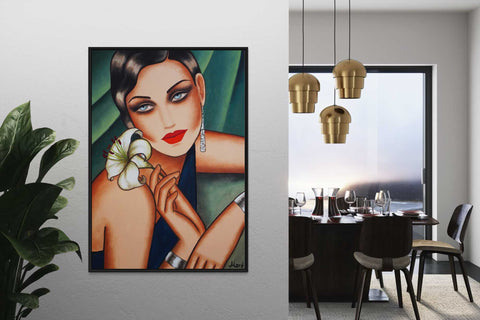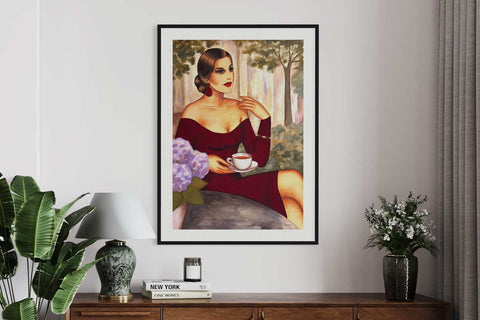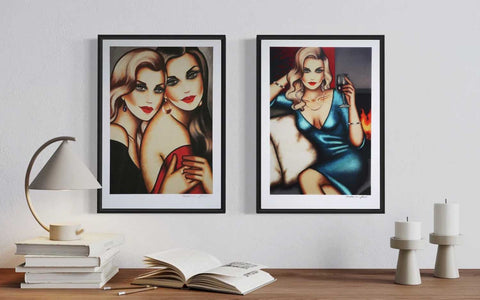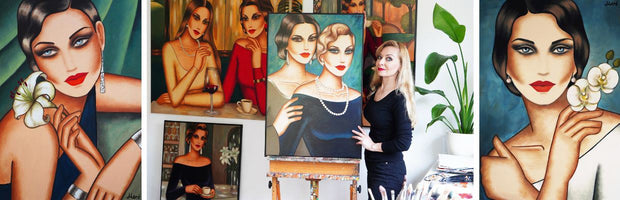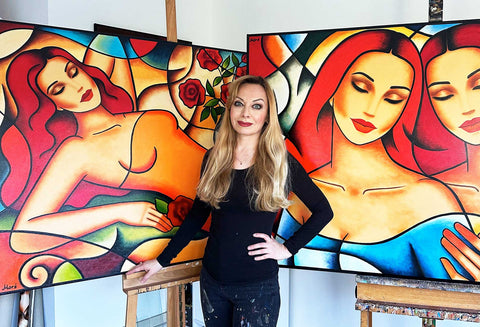
Flowism is more than an art style – it's a philosophy of life. Inspired by Csíkszentmihályi's concept of flow, this modern art style transforms colors and shapes into sensory experiences. In this article, I will show you how my Flowism art style originated, why it is so important today – and how it can inspire you to experience life with more ease and presence.
Do you sometimes feel like you're drowning in the currents of everyday life? Appointments, to-do lists, constant pressure – many people long for moments of letting go. This is exactly where flow comes in: a state of complete presence and inner balance.
Psychologist Mihály Csíkszentmihályi called it the key to happiness. But what if you could not only feel this state, but also see it?
Welcome to Flowism – my modern art style that translates the idea of flow into color and form. In this article, you will learn what lies behind the flow state, how it is activated through art – and why Flowism not only inspires but also heals.
1. From Chaos to Clarity – How Flow Works in Everyday Life

The alarm rings, and your head is already full: appointments, emails, a mountain of to-dos. Do you know this feeling of drifting in a turbulent sea without firm ground? This is where an idea comes in that can steer your life in completely new directions – Flow.
Perhaps you've already heard of this "optimal state of experience" where everything flows as if by itself. But what if this state could exist not only in your head but also on canvas? This is where my Flowism comes in: a modern art style that takes up Mihály Csíkszentmihályi's concept and translates it into colors, shapes, and sensory experiences.
Imagine you see a painting where bold color strokes seemingly effortlessly merge, just as your thoughts flow into each other in a perfect moment. A state where time plays no role and you completely lose yourself in the here and now. Flowism wants to show you exactly that: that you don't have to be tossed around by everyday waves, but can learn to surf them.
Curious why this is so important right now? In a world that pushes you for perfect performance and continuous optimization, true flow becomes an island of serenity – and my Flowism art style provides you with the visual anchor for it. In this article, you will learn how Mihály Csíkszentmihályi describes the flow state, what makes it so special, and why I incorporate it into my paintings.
2. What is Flow according to Csíkszentmihályi? ✨

Perhaps you're wondering, "Flow – sounds exciting, but what's behind it?" Mihaly Csíkszentmihályi, one of the leading happiness researchers, describes flow as the moment when you are completely engrossed in a task. You are challenged, but not overwhelmed. You feel focused and yet relaxed, as if everything is happening effortlessly. No distractions, no racing thoughts – just you and the activity.
In his book "Flow: The Psychology of Optimal Experience" he explains that happiness does not depend on chance or external successes, but on your inner attitude. As soon as you gain control over your consciousness and direct your senses to the here and now, new horizons open up. You suddenly realize that you are more than just someone who functions. You are someone who can go deep – just like listening to a wonderful melody or immersing yourself in a captivating work of art.
Csíkszentmihályi also speaks of a balance between challenge and skill. When you operate in this optimal range, you feel alive instead of stressed. This is the core: a state in which you not only function but truly live. And this is where enjoying art comes in. The more your perception of colors, shapes, and moods is trained, the more likely you are to reach this state of flow – whether creating or observing.
Because when you see a picture and completely immerse yourself in it, your mind can dive into the same depth that Csíkszentmihályi talks about. Then you briefly forget the to-dos and feel a kind of quiet tingle that tells you: "Yes, this is Flow."
3. Happiness and Inner Attitude ✨

Have you ever wondered why some people maintain a sparkle in their eyes even in difficult times? Csíkszentmihályi says: Happiness is less a question of external success than of your inner attitude. You can ride a wave of success and still be dissatisfied and restless – or find deep contentment in simple moments. The key lies in how you direct your attention.
Imagine you are in a crowded room full of voices and impressions. As soon as you decide to focus on something beautiful – for example, soft music in the background or a special smile – the entire atmosphere can change. This is exactly how happiness works, according to Csíkszentmihályi: It arises when you consciously focus on the positive, on something that is good for you and sharpens your senses for it.
From my artistic perspective, the enjoyment of art also plays a role here. The more you dare to truly perceive colors, shapes, and moods, the more intense your experience becomes. You learn not to be driven crazy by external standards, but to use your own perception as a source of joy. And that's exactly what I want to convey with Flowism: an art style that shows you how liberating it is to immerse yourself in the beauty of the moment, instead of letting yourself be overwhelmed by the hustle and bustle of everyday life. And so, the colorful kaleidoscope of your feelings, experiences, and perceptions can transition into a vibrant harmony.
4. Control over Consciousness – Parallels to Flowism ✨

Do you know the feeling when you get absorbed in an exciting movie and forget everything around you? This state doesn't arise because you're trying hard, but because you completely surrender to what's happening. Csíkszentmihályi calls this "control over consciousness" – an ability to consciously steer your attention instead of being dominated by external distractions.
It's similar with my Flowism. When I work on a new piece, I let colors and shapes flow into each other without strictly planning everything. I focus on the flowing transitions, the vibration of the lines, and the sensual effect of the colors. In this process, a harmony emerges that grows not through force, but through letting go.
This is exactly what is reflected in the finished picture: no angular dissection as in Cubism, but a state of floating. For you as the viewer, this means: as soon as you truly engage with a Flowism painting, it can happen that you forget your worries for a moment and find a kind of inner peace. This can happen completely unconsciously – the shapes and lines speak directly to your soul and help to structure the chaos we encounter daily. At the same time, you practice opening your senses – a small step towards more flow in everyday life. And who knows, maybe then you will feel how much strength you have within you when you fully engage in the here and now.
5. Challenges and Growth – why Flow shapes people ✨

Have you ever felt like everything is getting on top of you? This unbridled flood of tasks, expectations, and changes that almost makes you stumble? I know that feeling all too well. As a freelance artist, I constantly face new challenges: the rapid decline of traditional galleries, the growing competition in the online market, the question of how to remain authentic and visible in a world of AI images. And yet, I have learned to grow precisely in this tension – just as Csíkszentmihályi describes how people mature through their challenges.
In my Flowism process, it's similar. I constantly try new color combinations, new forms that push me out of my comfort zone. This can seem chaotic at first, but as soon as I fully engage, I find that state of flow where everything effortlessly clicks into place. Similarly, viewers of my works can experience a kind of "flow feeling" when they let themselves be carried into a new world by colors and lines. Then you feel that even the apparent chaos can help you develop further. You realize: "Hey, I can do more than I thought." And that's exactly what Csíkszentmihályi means by personal growth through flow – every hurdle becomes an opportunity to become stronger and freer.
6. Chaos vs. Order – How Flowism maintains balance ✨

Imagine you have a thousand things on your mind: appointments, worries, ideas, and somewhere in between, your own dreams are gathering dust. This chaos can be overwhelming, sometimes even leading to panic attacks. I've experienced it myself – as a young mother trying to juggle everything. It was precisely in this phase that my Flowism style emerged, as an answer to the question: How do I find order in this mess?
When I paint a new Flowism picture, colorful surfaces appear first, seemingly at random. But little by little, the colors come together to form a harmonious whole. This balance between chaos and order is the core of Flow: you let yourself be carried by the waves without drowning. And just as I bring my colors into a harmonious rhythm on the canvas, you can learn to unite the versatile within you in your everyday life. Instead of fighting every wave, you allow yourself to dance with the current. And suddenly you notice that even in the hustle and bustle, a quiet harmony slumbers, just waiting to be discovered.
7. Flow in Everyday Life – Practical Tips ✨

Do you sometimes feel that quiet restlessness when half the day is over and you haven't yet felt like you've really done something "of your own"? That's exactly why there are small exercises that can bring you into a state of flow – without hours of meditation.
-
Consciously perceive colors
Take a few minutes to really look at an object in your surroundings. Pay attention to nuances, light reflections, and shadows. This trains your senses and opens you up to the beauty in the ordinary. -
Small creative breaks
Whether you doodle a few lines on paper, calmly enjoy a cup of tea, or briefly close your eyes to listen to music – allow yourself to fully savor this moment. This is exactly where flow can emerge. It always helps me to paint dynamic lines and shapes on paper and let their energy carry me along. -
Focused activity
Choose a task that you do daily anyway and find rather annoying. Imagine you are absorbed in it like in a dance. It could be clearing the breakfast table or folding laundry. Block out distractions and concentrate fully on this activity. Allow yourself to get lost in this routine. If you engage in it, you might notice how time and doubts fade. - Dolce far niente – Practicing the sweet art of doing nothing
Allow yourself to simply do nothing. No goal, no plan – just sit still, breathe, look. Perhaps with a coffee by the window or a few minutes on the balcony. Let thoughts come and go like clouds. These small breaks are like islands of light in everyday life – they nourish your soul and remind you: You are allowed to just be.
These mini-exercises remind me of my own painting process: I immerse myself in colors and shapes, forget everything around me, and create something new. In the same way, you can sharpen your perception and taste life more intensely – a small step towards more flow in everyday life.
8. Why Flow and Flowism Belong Together ✨

Perhaps you're wondering what a psychological concept has to do with my art style. From my perspective, Flowism is the visual equivalent of what Csíkszentmihályi describes as "Flow". On my canvases, colors and lines merge, just as thoughts and feelings can flow into each other in our minds when we concentrate fully on the moment.
Instead of dissecting everything, as Cubism does, I rely on harmonious coexistence. Flowism wants to remind you of the state in which you feel free and alive – just like a real flow experience. The idea behind it: If you feel this hint of timelessness when looking at a picture, you have already had a taste of what is inside you.
Art appreciation here becomes a bridge between inside and out. The more you open your senses, the easier it will be for you to slip into flow. And that is exactly my motivation: to show you that art is not just beautiful to look at, but can be a key to expanding your perception and drawing new energy.
9. Summary

Flow according to Csíkszentmihályi is more than a concept. It is a way to rediscover yourself amidst chaos and expectations. If you deliberately direct your attention and train your senses for beauty, you can experience moments of true contentment – be it at work, while cooking, or when looking at a painting. Flowism takes up this idea and transforms it into color and form: Instead of rigid rules, there are flowing transitions, instead of fragmentation, a feeling of connectedness.
Curious? Then take a look at my Flowism works or read more in my main article on the subject. There you will learn how you yourself can cultivate more flow moments – and why art can be not just decoration, but a true elixir of life. Let's take the next step together to make life lighter, more colorful, and at the same time more intense.
👉 Discover more about Flowism:
➤ Article: "Flowism – A New, Modern Art Style for More Ease and Connection"
➤ Article: "How Cubism Inspired Me – From Picasso to My Flowism"
(FAQ) Frequently Asked Questions
What is Flowism art style?
Flowism is a modern art style by Ekaterina Moré that visualizes the flow state in colors, shapes, and emotional depth.
What connects Flowism with Csíkszentmihályi's theory?
Both rely on presence, inner balance, and creative expression. Flowism brings these principles to the canvas in an aesthetic form.
How can art help find flow in everyday life?
Colors and lines can have an emotional effect and calm the mind – Flowism opens these doors in a sensual way.
Can Flowism paintings be purchased?
Yes – original Flowism works by Ekaterina Moré can be found in her online gallery.
Is Flowism feminist?
Flowism expresses feminine strength, sensuality, and wholeness in a new way – as a visual response to fragmenting styles like Cubism.