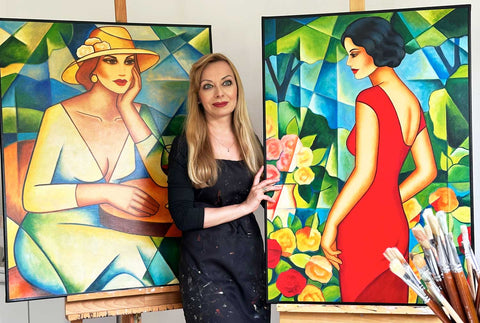
If you've ever wondered what an image can truly do to us – how it changes our perception, challenges our imagination, and touches our inner world – then you might see Cubism through different eyes.
My first encounter with this radical art movement wasn't in an art book, but in a museum that unleashed my childlike imagination: the Hermitage in St. Petersburg. I was still a child, but something about Picasso's paintings captivated me. These dissected faces, the geometric planes, the unusual perspective – I felt like I was in a riddle that could only be solved with the heart. Today, decades later, I know: This encounter was the beginning of a journey. A journey that didn't end with Cubism, but continued in my own style – Flowism. And that's exactly what I'm telling you about here.

1. The Moment That Changed So Much – Cubism in the Hermitage ✨
I still remember that day precisely: The soft light streamed through the tall windows of the Hermitage, and amidst all the portraits in gilded frames and sculptures, I suddenly stood before a painting that was different. It was a work by Picasso – angular, fragmented, strange, and at the same time magnetic. I couldn't say if I liked it. But I couldn't look away.
As a child, I was fascinated by colors, shapes, and mysterious connections. Cubism challenged me because it turned everything upside down: perspective, proportion, logic. I didn't understand what I was seeing – and that's precisely what captivated me. Why was this woman looking forward and to the side at the same time? Why was her face dissected like a puzzle?
In this irritation lay a magic. Now I know: Art doesn't have to explain. It's allowed to ask questions. It's allowed to disturb, provoke, stimulate thought. Perhaps it was precisely this moment that laid the foundation for my own artistic language. For a style that also shifts perspectives – but in its own unique, flowing way.

2. Understanding Cubism – More Than Dissected Forms ✨
Cubism is not just a style with angular shapes. It is a radical shift in perspective – a revolution against the classical, linear view of the world. Instead of showing a motif from a single viewpoint, Cubism breaks down the object into its facets and shows them simultaneously: front, side, sometimes even from behind – all in one image. This simultaneous viewing of different perspectives is called multi-perspective or multiperspectivity.
Pablo Picasso and Georges Braque are considered the founders of this movement. Later, artists such as Franz Marc, Robert Delaunay, and Lyonel Feininger joined, finding their own ways to further develop the principle. Delaunay's color dynamics and Feininger's rhythmic, musical prismism particularly touched me.
What connects them all is the dissolution of traditional perspective. While classical art creates depth through vanishing points, Cubism takes different approaches: It works with surface, with fragmentation, with simultaneous representation. The movement of an object, time itself, seems to be captured in the image. This is what makes Cubist works so vibrant – and sometimes so enigmatic.
For me, this was fascinating. It was as if these images transported me into a different mental space. One where it's not the depiction that matters, but the experience – the emotional, the visual, the intellectual.

3. The Search for Connection – Why Something Was Missing for Me ✨
Despite all the fascination, there was something that kept me at a distance internally. Cubism impressed my mind – but not always my heart. The geometric constructions, the fragmented faces, the intellectual sophistication – all of that was exciting. But I missed something: warmth. Flow. Connection.
Perhaps it was due to my own nature. I am deeply emotional, sensual, intuitive. In art, I don't just seek the new – I seek the tangible. And the longer I engaged with Cubism, the clearer it became to me: I wanted a different kind of depth. An emotional depth. I wanted an imagery that didn't divide, but connected. That didn't abstract to analyze, but to touch.
I often missed the symbolism too. Where was the femininity? The intuitive power, the mysterious flow, the sensual radiance? I began to suspect: If I wanted to express myself artistically, I needed something of my own. Something that incorporated elements of Cubism – but translated them into a new rhythm. One that breathed more. And this is exactly where my journey into Flowism began.

4. From Fragmentation to Flow – My Path to Unity ✨
Long before Flowism became a style, it was an inner need. As a woman, I often felt torn – between demands, thoughts, roles. Between the desire to be strong and the need to remain soft. Between external expectations and inner longings.
In this inner fragmentation, I sometimes lost myself. Just like the fragmented figures in Cubism, I felt analyzed, scattered, functional. But not connected. I longed for a flow – something that would gather me, make me whole, let me breathe.
For me, Flowism was not primarily an artistic decision – but a way back to myself. When I paint, I enter this state where everything becomes one: form, color, feeling. Thoughts become quiet, intuition becomes strong. Perhaps you feel that too when you look at my works. Perhaps this style helps you remember yourself. Remember what flows – and what makes you, you.

5. How My Style Emerged – The Birth of Flowism ✨
Flowism emerged from an inner need: the longing for harmony, for connection, for a flow between forms. Where Cubism cut, I wanted to join. Where geometric coldness prevailed, warmth was to enter. The contrast became the starting point: Angular analysis turned into rhythmic sensation. Intellectual distance into emotional closeness.
Art Nouveau played an important role in this. Its elegant curves, floral lines, and decorative lightness inspired me – but did not fully satisfy me. For I was looking for more depth. Not just aesthetic curves, but a spiritual movement. Something that not only enchanted but also touched something inside and resonated.
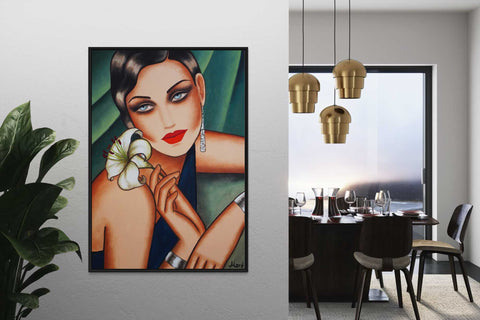
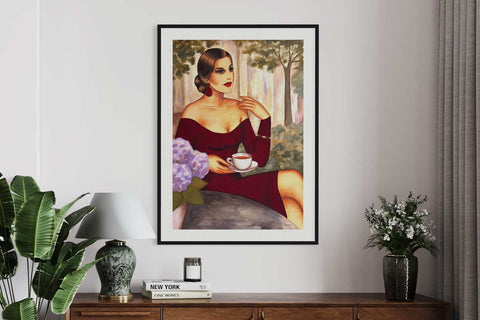
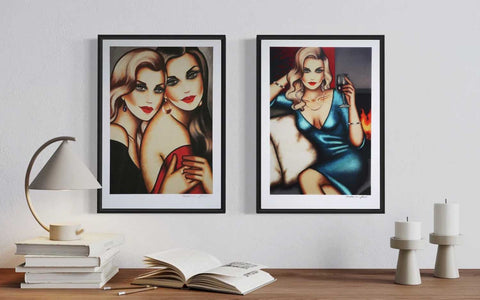
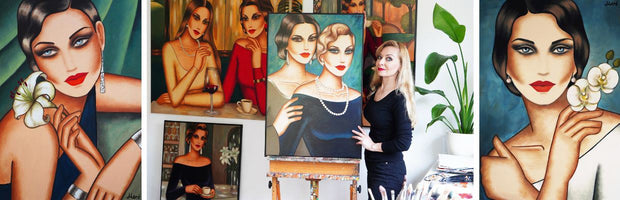
Thus, Flowism was born: a style that flows instead of separating. That embodies feminine principles, not just illustrates them – through shapes, colors, transitions. In my paintings, the woman is not an object but a symbol of the soul. Each work is an attempt to make the invisible visible: what we feel but cannot always grasp.

6. "Colorful Swing" and Other Works – Cubism as a Springboard ✨
Especially in my "Colorful Swing" series, the connection between Cubism and Flowism becomes clear. Here, I use broken perspectives and geometric planes – but not to fragment, but to create a rhythm. The forms dance. They interlock, push away, merge. It is a play between structure and emotion.
The female figures in these paintings appear to be in motion – not in the sense of action, but of inner swaying. Despite clear lines, everything remains in flux. For me, that is the essence of Flowism: Geometry serves not to dissect, but to connect. It structures, but it does not interrupt. It holds the space for something deeper: feeling.
I remember how the first works in this series came into being – almost like musical compositions. Colors became notes, lines melodies. And suddenly there was this vitality, this pulse, that said more than any explanation. That's exactly what I want to achieve: art that is not just observed, but experienced. That is not analyzed, but touched.

7. How I Recognized Myself in Dora Maar’s Fragmentation – and Reassembled Myself ✨
When I first saw Picasso's Cubist portraits of Dora Maar, I felt something unexpected: a faint echo within me. These angular forms, the fragmented features – they seemed abstract, almost alienated. And yet, they touched something very personal. I recognized in them a fragmentation that was familiar to me: between expectations and emotions, between role models and inner longings.
I too had often experienced myself as a figure composed of many parts – strong and sensitive, visible yet not entirely seen. The analytical gaze of Cubism left little room for softness, for intuition, for the quiet radiance of the feminine. And that's precisely what stirred me.
I wanted to find an artistic language that doesn't separate, but connects. An art that doesn't dismember, but heals. In my Flowism, women can be multidimensional: sensual, strong, vulnerable, radiant. Not as concepts or symbols – but as tangible soul presence.
My portraits don't show flawless shells, but inner worlds with depth. They tell of the power of female self-perception, of reconnecting with oneself. Every line, every color carries meaning – not analytically, but emotionally. Flowism gives the feminine principle a space where it can act. Without explanation. Without justification. Simply existing – fully.

8. Art That Moves – What My Paintings Tell Today ✨
My works are not mere compositions – they are encounters. Each painting is an invitation: to pause, to feel, to recognize. I believe that art is not only made for the eye – but for the soul. That it can touch something within us that we may have long forgotten.
The flowing lines, the luminous colors, the soft transitions: They tell stories without words. Stories of longing, joy, connection. And sometimes also of pain or new beginnings. It's not about interpretation, but about resonance.
When you look at my paintings, I don't want you to understand – but to feel. That something within you begins to vibrate. Perhaps just very subtly. Perhaps so much so that you think: This is exactly what I needed.
👉 Discover more about Flowism:
➤ Article: "Cubism vs. Flowism – Two Perspectives on Femininity in Art"
➤ Article: "Flow Meets Flowism: The Path to Creative Ease"
👉 Discover more about my art:
➤ Article: "Women's Images in Art – Why They Touch Our Soul"
Feel what moves you ✨
Cubism opened my eyes – to the power of shifting perspectives, to the freedom of form. But my heart led me further: to Flowism. To a style that doesn't divide, but connects. That doesn't explain, but moves.
If this journey has touched you – if you feel like diving deeper – then I warmly invite you to discover my works. Perhaps there is a painting waiting for you that will accompany you daily.
Discover my women's portraits in Flowism style now:
👉 Click here for the gallery
(FAQ) Frequently Asked Questions about Flowism & Artistic Inspiration
What exactly does "Flowism" mean?
Flowism is an artistic language that focuses on intuitive painting, flowing forms, and emotional resonance. The style emerged from my inner need for connection – as a counter-movement to the fragmentation of many modern trends.
How did Cubism shape you – despite your distancing?
Cubism taught me to rethink perspectives. But my path led further – towards a formal language that does not dissect, but connects. Flowism is my personal dialogue with this inspiration.
Is Flowism also interesting for collectors looking for emotional art?
Yes. Many of my buyers say they see themselves reflected in my paintings. Flowism appeals not only to the eye but to the heart – thus creating a deep, lasting connection to the artwork.
Can I have a painting in the Flowism style custom-made?
Certainly. I offer individual commissioned works tailored to your colors, moods, or life stages. A personal portrait can become an emotional anchor point in your home.