Sometimes I enter a room and immediately see: a lot has been done right here.
The materials match, the light is good, the furniture is carefully selected. Colors and proportions are right. And yet, later, hardly anything remains in memory.
Perhaps it's because beauty alone doesn't create personality.
Especially in high-end interiors, I often see art appear only at the very end of a project. The rooms are already planned, furniture and lighting are fixed. Then a free wall remains and the question: what do we hang there?
I'm much more interested in the opposite question:
What can art contribute to a room if it's not just meant to fill an empty wall?
That's where my collaboration with interior architects and interior designers begins.
Sometimes one of my existing works is exactly right. Sometimes a room needs a special format or a custom-developed piece. For larger projects, a coherent series of paintings can also emerge from this.
My goal is not to simply replicate colors, materials, or the style of the interior in the artwork. I find the question of what makes a place special and what additional mood or tension a work of art can create there much more interesting.
Because perhaps the most powerful image for a room is not one that blends in as unobtrusively as possible.
Perhaps it's the one that gives it something that wasn't there before.

1. When art becomes part of the room concept
When planning an interior, a lot of thought goes into materials, light, proportions, and sightlines. Art, on the other hand, surprisingly often only comes into play later.
Yet, a painting can profoundly change the perception of a room. It can guide the eye, bring calm to a large wall, or create a deliberate counterpoint to a very clear architecture.
For me, therefore, the work doesn't begin with the question of what color the painting should be.
Much more interesting is:
What feeling should this room evoke?
Should it be calm and understated? Sensual, elegant, or powerful? Should there be a place that surprises and is particularly remembered later?
Of course, colors and materials play a role. A painting interacts with wood, stone, fabrics, metal, and light. But it should retain its own voice.
Sometimes a work picks up a color from the interior. Sometimes a quiet architecture needs a painting with more energy. And sometimes it's the other way around: a room with many strong materials becomes more interesting with a calmer work.
I am fascinated by precisely this relationship.
Not perfect adaptation, but the moment when space and art begin to work together.

2. Why original art is interesting for interior designers
For me, direct collaboration holds a special appeal. I don't mediate between an interior designer and a large selection of different artists; instead, I bring my own visual language into the project. This allows an existing work, a commissioned piece, or a series to develop into a cohesive artistic idea that runs through the space.
Many elements in a high-quality interior can also reappear elsewhere. A special lamp, a piece of furniture, natural stone, or a fitting remains a product that can, in principle, be used multiple times.
With an original painting, it's different.
There is exactly this one work.
Precisely therein lies, for me, a special value of original art in interior design. It can give a project something that cannot be ordered from a catalog.
This doesn't mean that every room needs a spectacular work of art. Sometimes a single painting in the right place is enough. But this one work can make the difference between a very beautiful room and a truly individual one.
For interior architects and designers, this is particularly interesting if they want to offer their clients something that isn't seen everywhere.
In my opinion, this particularly applies to smaller and medium-sized interior design studios. Not every project can be furnished with custom-designed furniture or completely individually produced objects. An original painting or a specially developed series of images can nevertheless introduce a very personal touch.
Art as part of your project signature
Every good interior designer develops their own signature over time. You recognize certain decisions, a way of handling materials or colors, perhaps even a special eye for detail.
Art can complement this signature without copying it.
The room remains the creative work of the interior designer, and the painting is my work as an artist. This independence is precisely what I find important. When both work well together, the result is not a completely styled backdrop, but a space with tension and personality.
In addition, there's something that often only becomes apparent later with individually developed art: the story behind the work.
Why was this particular format created? What connects the motif to the place? How was a series developed?
Such questions can become part of a project presentation, be picked up on a website or in social media, and – depending on the project – also provide material for further communication. Not as an artificially invented story, but because something unique was actually created for this place.
➤ To the article: "Art for Hotels – Original Art for Boutique Hotels and Hospitality Interiors"
➤ To the article: "Art for Doctors' Offices and Clinics – How Health Spaces Can Foster Trust and Well-being"

3. What I pay attention to in an interior project
When I look at a room, some things particularly interest me.
Architecture and sightlines
Where do people encounter a painting?
Is it visible as soon as you enter the room, or do you only discover it later? A wall perceived from a great distance requires a different solution than a work in a smaller, more intimate area.
These sightlines also determine how prominent a painting should be and what format works.
Proportion and format
Sometimes the format is more important than the motif.
A tall, narrow wall might call for an unusual portrait format. Elsewhere, a single large work might be more impactful than several smaller paintings.
This is precisely where special formats can become interesting, as standard sizes don't always match the proportions of an architecture.
Materials, colors and light
Of course, I also look at the materials and the color scheme of a room. Wood interacts differently with a painting than cool stone or metal. A red changes depending on the surroundings and light.
Daylight and artificial lighting also play a role, especially with intense colors, glossy surfaces, or gold elements.
In doing so, I don't try to find all the colors of the interior reflected in the painting. Sometimes the most beautiful connection arises precisely through a small deviation or a deliberate contrast.
The use of the room
A restaurant has different requirements than a private clinic. A hotel lobby functions differently than a bedroom or a quiet waiting area.
For me, there is no simple formula for what art belongs in which room.
What is crucial is how this place is used and what atmosphere should be created there.
Art should belong to the room without becoming art that matches the sofa.

4. What form of original art suits the project?
Not every project automatically needs a newly developed commissioned work. Basically, there are three options I would consider with an interior designer.
An existing original painting
Sometimes, among my existing works, there's already a piece that naturally fits into a room.
This has the advantage that the size, surface, and actual color effect are already established. The painting can be visualized directly in the room, and it quickly becomes clear whether the proportion works.
I really like such surprising encounters. A work created independently of a specific place can suddenly appear in an interior as if it were meant specifically for it.
A selection of existing original works can be found in my online gallery.
An individual commissioned work
If a wall has special proportions or if a particular pictorial idea within my artistic world is to be further developed, an individual work can be useful.
It is important to me that the project also fits my work artistically.
Therefore, I do not see a commissioned work as a mere order, but as a collaboration: the space and the interior provide a framework within which enough freedom for an independent painting must remain.
A coherent series of paintings
For larger projects, it can be useful to connect several works with each other.
This does not mean that all pictures have to look the same. Often the opposite is more interesting.
A series can be held together by colors, certain shapes, motifs, or a common atmosphere. This creates a visual thread between different rooms, without the works appearing like a perfectly matched set.
Especially in hotels, practices, or larger residential projects, this can be a very beautiful solution.
If you would like to learn more about how individual paintings and series of paintings are created, you can find my detailed article on commissioned art here.

5. Custom art – but not matching the sofa
The phrase "custom art" quickly sounds as if a painting can be configured just like a piece of furniture: choose size, determine color, specify motif – done.
That's not how I work.
Of course, with an individual work, special formats and custom sizes can emerge. I can adopt a specific color direction, develop a calmer or more powerful visual effect, or elaborate a floral or figurative motif within my own visual world.
Coherent series or variations of an existing pictorial idea are also possible.
What I do not want, however, is to translate a mood board as precisely as possible onto canvas.
If a painting only works in the end because the color perfectly matches the sofa, that would be artistically insufficient for me.
I am much more interested in how a work can relate to a room and still bring something of its own into it.
Perhaps it picks up a color only in a small spot. Perhaps it deliberately creates a contrast. Or it introduces an organic form into a very clear architecture.
For me, that is the more exciting form of custom art:
not art that subordinates itself to the room, but art that develops a special relationship with that place.
➤ Learn more about original art for living spaces

6. How collaboration with an artist can look
For an initial inquiry, a finished art plan or a perfect presentation is not necessary.
Many interior projects are still in flux at this point. Materials are being selected, renderings are changing, or a room initially only exists on paper.
This is not a disadvantage. On the contrary: the earlier art is considered, the more possibilities remain open.
1. Getting to know the project
For me, it starts with a personal conversation.
I want to understand what makes this place special, who will use it, and what atmosphere should be created. Are there areas that should be deliberately highlighted? Is there an idea that runs through the entire interior?
This usually quickly reveals whether and how my work could fit the project.
2. Understanding the space
Helpful information subsequently includes room photos, renderings, floor plans, wall measurements, material or color concepts, and mood boards.
Not all of this is necessary.
Sometimes a good rendering and a description of the project are sufficient; for other rooms, the floor plan and sightlines are more important.
3. Developing an artistic direction
Then I look to see if one of my existing originals would be suitable, or if an individual work or series would make more sense.
This involves, among other things, format, position, desired presence, and the question of which of my artistic worlds might fit the project.
4. Visualizing the work in the room
Especially for larger formats, I find a digital room visualization very helpful.
A painting can have an enormous effect on a neutral wall, and then suddenly appear much smaller on a tall wall in the real room.
A visualization can compare different sizes, positions, and works before a final decision is made.
5. Implementation
Once the direction is set, the format, work, timeframe, and other details are coordinated.
For an existing original, the focus is on the concrete implementation. For a commissioned work, the actual painting process begins.
Despite all previous coordination, something always remains open. A painting evolves during the painting process. This is precisely what, for me, makes a true original.

7. Two Visual Worlds for Different Rooms
My floral and figurative works have a different presence. Nevertheless, I would never dictate that a particular visual style exclusively belongs in a specific room.
What's more interesting is what's already there and what the room is still missing.
Floral Glamourism – Organic Forms and Sensual Color
Flowers have long accompanied my work. I am interested in their shapes, their movement, and the possibility of bringing something organic into a clear pictorial composition.
In my floral works, flowers often become larger, freer, and sometimes almost abstract. Depending on the color scheme, the paintings can appear very vibrant or surprisingly calm.
Especially in interiors with stone, wood, glass, or understated materials, this organic counterpoint can be exciting.
Therefore, I see floral works in hotels as well as in high-quality practices, clinics, wellness areas, or private rooms.
A floral painting does not have to appear romantic at all. It can be equally powerful, graphic, and modern.
➤ Learn more about Floral Glamourism
Feminine Glamourism and Neo Deco – Personality in the Room
Female portraits have a different effect.
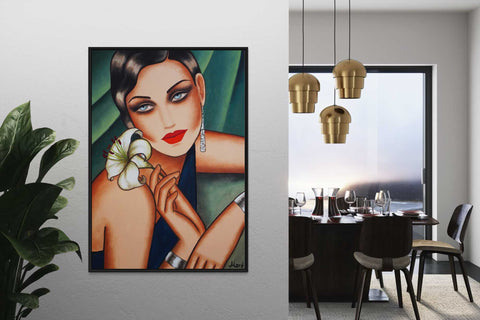
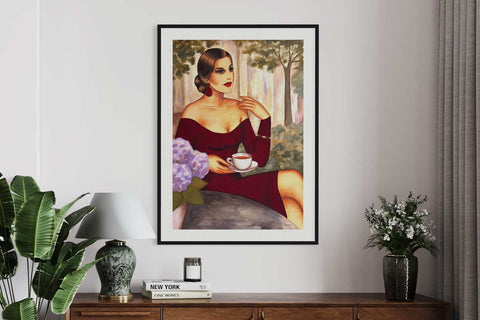
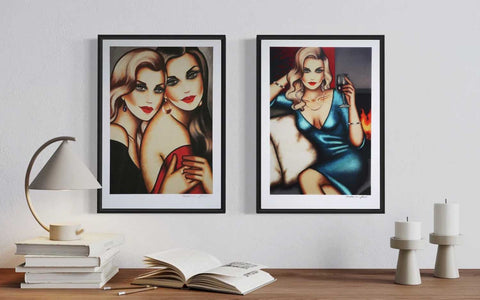
We react immediately to faces and gazes. A large portrait can therefore almost act as a counterpart in the room and quickly give a place character.
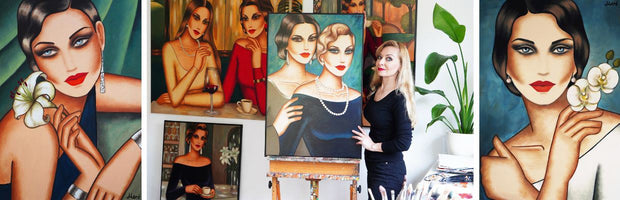
My figurative works often combine clear forms, intense colors, and an Art Deco aesthetic. They can be elegant, sensual, and self-assured at the same time.
Especially in restaurants, bars, lounges, hotels, or representative areas, this stronger presence can be interesting.
But even here, there is no fixed rule. A floral work can function wonderfully in a bar, and a female portrait can be surprisingly harmonious in a quieter environment.
In the end, it's not about the category of the motif, but about the question:
What should this room evoke in the people who enter it?
➤ Learn more about Feminine Glamourism

8. Two Projects: How Art is Created for a Specific Space
The collaboration between art and interior design can be most clearly demonstrated through concrete projects. The requirements can be very different. In a hotel bar area, it might be about character and staging, while in a private clinic, it's about a completely different atmosphere and works that develop their own visual world across multiple rooms.
Maritim Hotel – Women's Portraits for an Art Deco Bar Area
For an exclusive bar and lounge area of the Maritim Hotel, I developed several large-format original paintings in Art Deco style.
The room itself already had a very distinct character: dark wood, red upholstery, mirrors, brass details, and a rather classic, almost theatrical atmosphere. The art, therefore, should not act as a subsequent decoration, but rather embrace this character and simultaneously bring something of its own to it.
Four large-format female portraits were created for the long lounge bench, functioning as a coherent group. Another three works were developed for the narrower wall areas between the windows.
The different wall surfaces were particularly interesting. A proper sequence of images could be created above the long seating bench, while the narrow areas between the windows demanded vertical formats. Thus, an existing image was not simply used multiple times, but the series was adapted to the architecture of the room.
The color palette of the women's portraits also incorporates elements of the interior: red, black, green, and warm skin tones combine with the dark wood surfaces and red seating. Nevertheless, the paintings remain very present. The women appear almost like additional personalities in the bar.
This balance is precisely what I find exciting in such projects: the art is visibly part of the room without disappearing into it.
Private Practice Asantae – Art for Reception, Hallways, and Treatment Rooms
The task at the private practice Asantae was different.
Over a longer period, several portraits of women were created specifically for the reception area, hallways, and various treatment rooms. The works are sensual and colorful, intended to create a more human, personal level within the clear practice architecture.
Different forms of presentation were chosen depending on the room. Some original works were framed behind glass, while others, as original paintings on canvas, are directly in the room.
The project became particularly interesting again after the renovation of the waiting room.
For this area, I developed a coherent series of seven stylized goddesses. The theme did not arise by chance: the visual world was intended to relate to gynecology and the orientation of the clinic.
This gave the art an additional layer. The works not only had to function in terms of color and space, but could also establish a thematic connection to the location.
For me, this is precisely a very beautiful possibility in individual interior projects. An art concept can develop from the architecture, but also from the history, function, or identity of a place.
➤ Learn more: "Women's Portraits for Medical Practices – Art for Gynecology & Aesthetics"
Not the Room Type, but the Idea Behind It Decides
At first glance, the Maritim Hotel and the private practice Asantae could hardly be more different.
In the hotel bar, large-format Art Deco female portraits contribute to the staging and special character of the room. At Asantae, art extends through various areas of the clinic, and later, with the goddess series, even directly related to the theme of women's healing.
This is precisely why I prefer not to work with fixed rules like "this art belongs in hotels" or "that art is suitable for practices."
What interests me much more is the question of what makes a place special and what artistic idea can emerge from it.
For me, this is also the point where the selection of individual images actually becomes an art concept for a room.

9. If you are planning an interior project
If you are looking for independent original art for a current or planned interior project, please feel free to send me initial information about the space.
This can include photos, renderings, floor plans, wall dimensions, or a mood board. However, it's also sufficient if you initially describe what the project is about and what atmosphere you want to create.
In a personal conversation, we will look at what makes the place special and which of my artistic visual worlds could fit.
Perhaps one of my existing original paintings is already the right solution. Perhaps an individual work or a series will be created.
If it makes sense, I can visualize the selected works or initial ideas in the room beforehand.
For me, a good collaboration does not begin with the question of which picture is currently available.
It begins with the space – and what art can give to it.
Are you planning an interior project? Feel free to send me initial room photos, renderings, or some information about the project. I will look at which of my works or visual worlds might fit and whether an individual solution would be appropriate.
For suitable projects, I can also create an initial room visualization.
Discuss project with me: info@ekaterina-more.com
Frequently Asked Questions about Working with Interior Architects and Interior Designers
When should art be integrated into an interior project?
Ideally, art should not be considered only at the very end. If important wall surfaces and sightlines are known early on, there are more possibilities for format and placement. However, integration is also perfectly possible if materials and furnishings are already decided.
Do you work directly with interior architects and interior designers?
Yes. I work directly with interior architects, interior designers, and other planners if my artistic visual language suits the project. Available options include existing original paintings, individual commissioned works, special formats, and series for multiple rooms.
Can paintings be color-matched to an interior?
Yes. The color schemes of an interior can be taken into account in an individual work. For me, it's not about an exact match to fabrics or wall colors, but about creating a connection to the space while maintaining the artistic independence of the painting.
Are individual formats and special sizes possible?
Yes. For interior projects, individual formats can be useful if the architecture demands particular proportions. Larger works or interconnected pieces for multiple areas are also possible.
Can you develop a series of paintings for multiple rooms?
Yes. A series can connect different areas of a project. The works do not have to be identical, but can be related through colors, shapes, motifs, or a shared atmosphere.
What documents do you need for an initial assessment?
Helpful documents include room photos, renderings, floor plans, wall dimensions, and material or color concepts. Not all of these are necessary. Often, a good rendering and some information about the desired room effect are sufficient.
Do you create a room visualization in advance?
Yes, if it is useful for the project. A digital room visualization is particularly helpful for larger formats, allowing realistic comparison of sizes, positions, and different works before a final decision is made.
How much lead time should be planned for a commissioned work?
That depends on the format, scope, and project phase. For individual works or series of images, an early inquiry is advisable to allow sufficient time for coordination, visualization, and artistic execution. I determine the specific timeframe individually for each project.