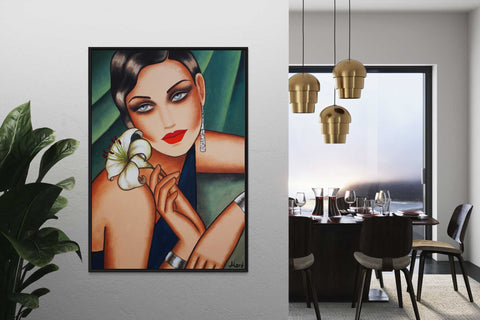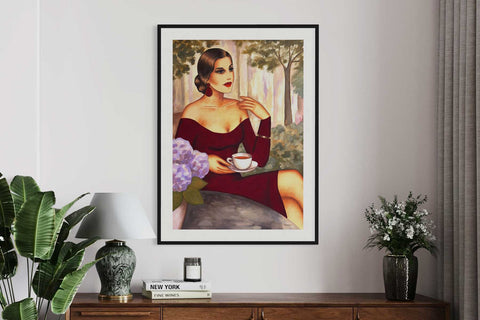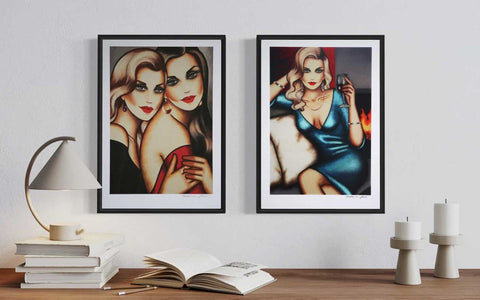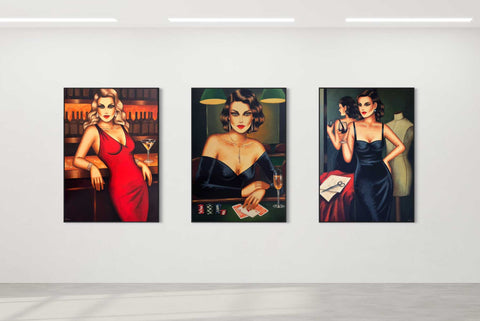
A client recently picked up a new painting from me. He already owns several of my female portraits. In conversation, he mentioned a large blank wall in his home. Perhaps, he mused, floral works could hang there. They would complement the female portraits while bringing a different mood to the room.
This thought stayed with me. Because the client wasn't just looking for another picture for an empty wall. He was considering how the works he already owned could be complemented by new pieces. Without consciously planning it, he had long been collecting art.
This is often how a personal art collection comes into being. Not according to a fixed plan. Not because one day you decide to become a collector. But because the first picture changes something: the room, your own perspective, and sometimes the desire to explore more of an artist's world.
1. Art collecting rarely starts with art knowledge
Many people tell me, "I don't really know anything about art." Behind this often lies the fear of making a mistake when buying art.
I understand this uncertainty. Nevertheless, I believe that specialist knowledge is not crucial for the first encounter with a painting. You see a special motif, a gaze, a posture. Something attracts attention. Perhaps you can't even explain why yet. But you want to look again.
That's how it usually begins.
A female portrait can evoke a certain aspect of one's own personality. A floral work might awaken memories of a garden, a journey, or a season. Sometimes it's just a color combination that immediately feels familiar. Such reactions are personal. They don't have to be art-historically justified to be valid.
Later, curiosity often grows. You want to know how a series came about, what the artist was thinking, or how her work has evolved over the years. This knowledge can deepen the connection to a work. But it is not necessarily at the beginning.
You don't have to be an art connoisseur to choose a painting for yourself. What matters is whether you want to see it again.
If you are currently looking for your first original, you will find practical guidance in the article Buying Original Paintings – what really matters.

2. Buying art is also a personal encounter
Buying an original feels different from a normal purchase. This is, of course, due to the work itself. But it is also due to everything that happens around that moment.
Some clients encounter my paintings at an exhibition. Others discover a work online and write to me. We talk on the phone, exchange photos, or speak via video. A very personal contact can also arise from this.
I then learn which gaze or color captured someone. Where the painting will hang later. Whether it's a gift or a reminder of a special phase of life. Sometimes a client sees something in a painting that I hadn't even thought of while painting. Such conversations surprise me too.
Many of my clients appreciate precisely this: they don't buy a painting anonymously, but learn something about its creation and about the person who painted it. And I get to know a little about the person with whom my work will live in the future.
For me, that's part of art. For centuries, paintings have been passed on, collected, and become part of private spaces. Whoever acquires an original continues this story in their own unique way.
3. Only in your own home does a painting reveal its full impact
In the studio or on screen, you see a painting for a limited moment. At home, a different experience begins.
Light moves across the surface. In the morning, some colors appear brighter; in the evening, other tones emerge. Over time, you discover small lines, transitions, or traces of paint application that were barely noticeable at first glance.
The space also changes. A previously inconspicuous wall gains significance. Furniture, materials, and colors suddenly appear more consciously related. A painting can organize a large living area, emphasize a sightline, or give warmth and personality to a very clearly arranged room.
And then the work becomes familiar. You walk past it daily. Visitors stop in front of it. At some point, it becomes so much a part of your home that only when traveling or moving do you realize how accustomed you have become to its presence.
This is what I mean when I talk about living with art. An original isn't equally interesting every day. But it can be seen differently again and again over many years.
I show how particularly large works can shape a room in the article Large-format Art for the Living Room.

4. After the first painting, the perspective changes
When buying art for the first time, the focus is usually on that one work: Do I like it so much that I want to have it in my home?
If an original is already hanging in the room, the question shifts. Now you no longer just see the individual picture. You begin to perceive connections.
Which colors are already present in the room? Should the next work pick up on this mood or consciously add something new? Does the blank wall need a strong counterpart – or would a calmer painting be better? Could two motifs relate to each other?
This doesn't mean that everything has to match perfectly like fabric patterns and wall paint. Art is allowed to be individual. Precisely this creates tension.
An expressive female portrait can become the focal point of a living area. A floral painting in the dining room or hallway can pick up a color or a line without repeating the female portrait. Both works remain independent. Nevertheless, you notice that they come from a related artistic world.
My visual worlds of Feminine Glamourism and Floral Glamourism can therefore be combined well. The motifs are different, but color, clear lines, elegance, and the conscious use of surface create a connection.

5. Cohesion does not come from uniformity
A personal collection does not have to consist of the same series or identical formats. On the contrary: if everything is too precisely coordinated, the arrangement can quickly look like a decorative garnish.
It becomes more interesting when the works are related but do not tell the same story.
A connection can arise through individual recurring colors. Through lines, metallic surfaces, or a similar tension between figure and background. Sometimes a shared attitude to life is enough. In other cases, it is precisely the contrast that makes the combination convincing.
One client owns early works of mine on paper, later female portraits, and floral paintings from different years. The works do not all look alike – and that is precisely their strength. Together, they not only show what the client has chosen over time. They also tell something about my development as an artist and her connection to it.
I have experienced several times that clients started with a single painting and years later owned five, seven, or even more of my works. This was rarely planned in advance. With each new work came a different moment, a different space, or a new discovery.
Thus, a collection gets its cohesion not from a fixed formula, but from a person's decisions.

6. Over the years, a collection becomes a personal story
In longer conversations about art, I often learn when and why a work was purchased. The first original may have hung in a previous apartment. Another was added after a move. One painting was a birthday gift, another reminded of a trip or a new beginning.
An outsider might not necessarily see such meanings in the work. But for the owner, they are still there.
One's own taste also doesn't remain completely static. Perhaps at first, one primarily liked bright colors and later discovered calmer works. Perhaps the human figure was important at first, and a few years later, floral motifs were added. The earlier choice is not thereby rendered wrong. It shows who one was then – and the new additions complement what has become important in the meantime.
A private art collection can therefore have a very biographical aspect. It does not consist solely of pictures. It preserves decisions, encounters, and phases of life.
7. Sometimes the next work doesn't exist yet
It happens that a client wants to complement an existing painting, but cannot find exactly what the room or the collection needs in the gallery.
Perhaps a specific format is missing. Perhaps a floral work should incorporate colors from an existing female portrait. Or several rooms are to be connected by a small series.
In such cases, a commissioned work can be useful. The existing painting is not copied. It rather serves as a starting point for the conversation: What should be preserved? Where can something new emerge? What size does the wall need? What effect should the new work have in the room?
From this, I develop an independent original in my artistic language. It matches the existing works without being subordinate to them.
You can find more about the possibilities and the process in the article Commissioned Art – individual original paintings.

8. No one has to decide to become a collector
Perhaps you don't own an original yet. Perhaps a painting already lives with you and you are considering what might go well with it. Or you have bought works over the years and only realize in retrospect that a collection has emerged.
There is no minimum number from which you can call yourself a collector. And you don't have to use this term at all.
Something else is more important: that you choose pictures that you like not just for a brief decorating trend. Works that arouse curiosity, trigger joy, or appeal to a side of you for which there are not always immediate words.
Sometimes it remains a single painting. That's perfectly fine too. Sometimes a collection gradually grows from it. Both begin with the same honest question:
Do I want to live with this work?

9. Which work could suit your paintings?
Perhaps your collection is just beginning. Perhaps you already own several of my works and are looking for an addition for a specific room.
If you are unsure, feel free to send me a photo of the wall and the existing works. Often I can already tell what format would be sensible, which visual world could create a connection, and whether an available original is suitable.
Sometimes the right solution is already in my studio. Sometimes a new idea emerges from the conversation.
Discover current original paintings or write to me for personal advice: info@ekaterina-more.com
10. Frequent questions about art collecting
How do you start collecting art?
Usually with a work that you really want to own and see regularly. A personal collection at the beginning does not need a fixed concept or extensive art knowledge.
Do the works in a collection have to be by the same artist?
No. A collection can combine different artists, eras, and techniques. However, some people collect multiple works by one artist because they feel connected to their visual language or want to follow their development.
How can female portraits and floral works be combined?
The paintings do not have to have the same colors or the same format. Connections can arise through individual color tones, lines, materials, a similar expressive power, or a shared sense of elegance.
How do I find a second work to accompany an existing painting?
Don't just consider the colors. Size, motif, viewing direction, effect, and placement in the room are also important. A photo of the wall and the existing painting helps with a concrete assessment.
Can a commissioned painting complement an existing collection?
Yes. Format, color scheme, and pictorial idea can relate to existing works and the intended space. Nevertheless, the new painting remains an independent original.