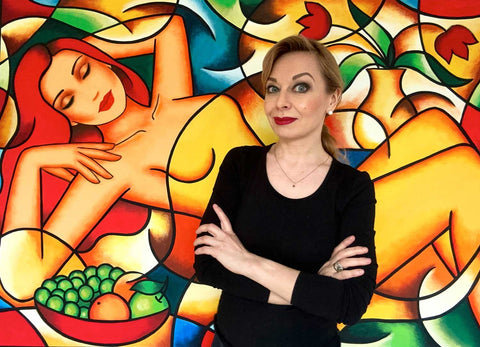
Cubism revolutionized the depiction of women in art—and at the same time, fragmented it. In many well-known Cubist works—by Picasso or Braque, for instance—women are not portrayed as feeling subjects, but as objects of analysis: dissected into geometric shapes, abstracted to the point of unrecognizability. This Cubist depiction of women reflects a perspective that fragments femininity—aesthetically and compositionally intriguing, but emotionally distant. Anyone who examines the depiction of women in Cubism today quickly realizes: It lacks emotion, intimacy, and interiority. Today, many female artists—including myself—ask: How can we counter this perspective? Don't we need new representations that show female wholeness, sensuality, and emotional presence?
Perhaps you remember an image that both fascinated and alienated you—a portrait that raised more questions than feelings. That's exactly how I felt when, as a young woman, I first stood before an original Cubist painting by Picasso. I was impressed—and at the same time, disturbed. Because something was missing: the beautiful soul. This experience never left me. And today I ask myself: What happens to our self-perception when we only find ourselves in fragments—in a world that already dissects us into roles?

1. Women in Cubism – Object, Fragment, Muse
In classical Cubist art, women were often not the active subject—but a projection surface of male imagination. The female figure was dissected, abstracted, de-individualized. She was a muse, a model, a symbol—but rarely an "I." Instead of empathy, there was distance. Instead of sensuality: structure. Instead of inner life: analysis.
This is particularly evident in the works of Pablo Picasso. His Cubist female portraits show faces breaking apart in different directions, bodies reassembled like puzzle pieces. These images are considered masterpieces of modern art—yet at the same time, they carry a profound alienation. The woman is not depicted as a feeling being, but as an aesthetic concept. Her inner life remains silent.
Georges Braque and Juan Gris also followed this principle: the woman as a compositional element, not as a personality. The fragments may have been formally innovative—but they reveal little about the life, experiences, or perception of femininity. And this is where my discomfort begins.
Because art shapes our view of the world. It creates visual habits. If women are predominantly depicted as abstract forms for decades—what does that do to our collective gaze? And more importantly: What does it do to us women ourselves? What happens when we are not allowed to find ourselves whole in art—but only as parts of an aesthetic game?
These questions stirred me. And they became a driving force for my own artistic quest.

2. Picasso, Braque & the Aesthetics of Distance
An iconic example of the Cubist depiction of women is Picasso's "Femme assise" from 1939—a portrait of his then-muse Dora Maar. At first glance, it is powerful, expressive, and richly colored. But the longer you look, the more you feel: This woman was not painted to evoke emotion—but to be analyzed.
Her face appears like a prism: split into triangles, shifted, harshly contoured. The famous Cubist lines traverse her form like a grid. What remains is a construction—not empathy. An image that says more about Picasso's gaze than about the woman herself.
Similar depictions can be found in Braque's works. Female bodies as geometric planes, fragmented into perspectives that create distance, not intimacy. It's not about relationship or feeling—but about form and structure. The woman becomes a means of pictorial composition. Her inner life remains hidden.
This aesthetic of distance bothers me. Because I know what that feels like. As a woman, not to be seen for who you are—but only for what you "represent." As a projection surface. As a figure.
That's why I ask myself: What happens if we view these images not just art-historically—but emotionally? What is missing in these portraits? For me, it's life. The soul. The story lost between the lines.
And that's exactly where my art begins.

"Dreamer with 3 Oranges", 140x100cm, 2002
3. What these images evoked in me
When I came to Germany at 19, my life was full of contrasts. I was between two cultures, two languages, two identities. A young woman—in the midst of searching for herself. And when I first saw Picasso's works, I felt: There's something strangely familiar here. These dissected faces, these split perspectives—they mirrored my inner turmoil.
But at the same time, there was discomfort. Because while Cubism fragmented, I sought connection. I didn't want to fall apart; I wanted to feel whole. And as a young mother, caught between a child, a new beginning, and self-discovery, this feeling of fragmentation was particularly present. I felt how many women in our time—torn between expectations, roles, perfection, and longing—feel.
It was during this time that one of my first works, "Dreamer with 3 Oranges" (2002), was created. It is strongly inspired by Cubism—with geometric shapes, clear contours, and compositional structure. But something is different: The woman in the picture is not fragmented. She rests. She dreams. She remains whole.
Looking back, I see: This painting was my silent resistance. A first, delicate statement that women are more than projection surfaces. That we need depth. Calm. And above all: wholeness.
Perhaps you recognize yourself in it. Perhaps you, too, sometimes feel this inner puzzle. And are searching—like I was then—for an image that brings you back together.

"Feel Free", 140x100cm, 2023
4. Between Demand & Longing – Why new images of women are necessary
We live in a time when women are expected to be everything: successful, beautiful, intelligent, caring—and always confident. Societal demands are high, as is the longing for inner peace. Many women feel torn between self-realization and adaptation, between outward glamour and inner emptiness.
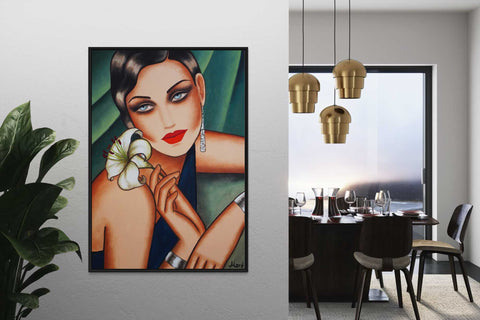
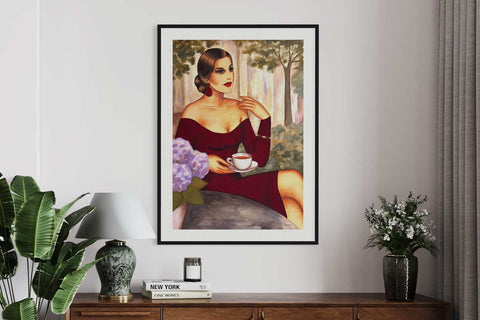
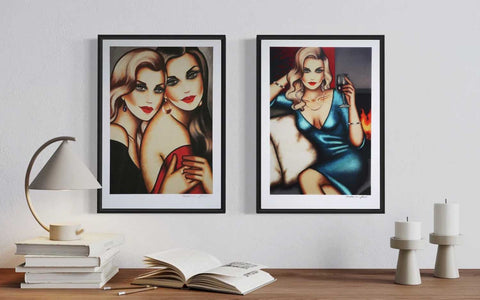
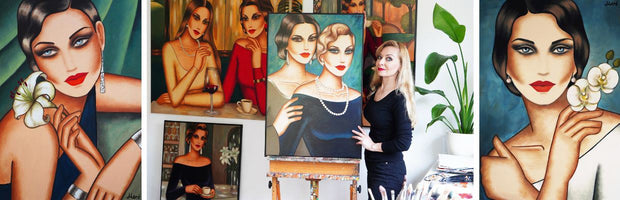
This is precisely where my Flowism comes in. It is not an escape from reality—but a conscious counter-image to everything that fragments. In my style, women are allowed to be soft, strong, to dream, to rest, to shine. Not as an ideal, but as an invitation to reconnect with oneself.
My current work "Feel Free" embodies this attitude in a special way: The woman dances a sensual dance with life. Her posture is fluid, her eyes closed—completely lost in herself. Surrounded by rhythmically moving color fields, she appears enveloped in a quiet "yes" to life. No compulsion, no role—but pure being.
While classical Cubism dissected and analyzed the female figure, my Flowism celebrates the return to wholeness. "Feel Free" is not a portrait in the classical sense—it is an inner state. An invitation to experience oneself as complete again. Connected. Sensual. Alive.
Because perhaps healing begins not with an explanation—but with an image that makes you dance again.

"Endless Summer", 100x70cm, 2023
5. Art may question – and connect
For me, art was never merely decoration. It is a mirror, a question, a memory—and sometimes a quiet wake-up call. Cubism opened up a new way of seeing the world, yet especially regarding the depiction of women, much was lost: wholeness, sensuality, emotion.
With my style, Flowism, I aim to bridge this gap—not as resistance, but as an expansion. I see my art as an invitation to a new balance: between strength and softness, between thinking and feeling, between external roles and inner being.
When you look at my works, you might not "understand" everything. But perhaps you will feel something—a moment of calm, a remembrance of yourself, a small longing for more depth. That's exactly what I paint for: to open spaces where you can be whole.
Female integrity—for me, that means not having to divide oneself. Not having to function. But to flow. To feel oneself. And to reclaim oneself.
🎨 Would you like to see what my modern women's paintings look like today?
In my Flowism collection, you'll find originals that depict femininity anew: powerful, fluid, sensual.
👉 Go to the online gallery "Flowism"
Or read my other articles on the topic:
➤ Article: "How Cubism Inspired Me – From Picasso to My Flowism"
➤ Article: "Cubism vs. Flowism – Two Perspectives on Femininity in Art"
➤ Article: "Flow Meets Flowism: The Path to Creative Ease"

FAQ Frequently Asked Questions about Classical Cubism
What is the problem with female depictions in classical Cubism?
Cubism often portrayed women in a fragmented and analytical way—as objects of aesthetic dissection, not as feeling individuals.
How did Picasso influence the depiction of women in art?
Picasso's works, such as the portraits of Dora Maar, stylistically shaped the image of women—often with a distant, dissecting perspective.
Why is this topic still relevant today?
Because many women still feel torn—between roles, expectations, and self-images. Art should reflect this experience and show new paths.
What is Flowism?
Flowism is a modern art style by Ekaterina Moré—it stands for female wholeness, fluid forms, and soulful resonance.
Where can I find modern female portraits in the Flowism style?
In Ekaterina Moré's online gallery, you will find works that make female strength, sensuality, and depth visible in a new way.