What does a female portrait reveal about our image of femininity – and how much does artistic style shape this statement? This is precisely where two seemingly opposing worlds meet: analytical, structured Cubism and my own emotionally connected style, Flowism.
Cubist works dissect the figure into facets and perspectives – an intellectual game with perception. Flowist images, on the other hand, strive for wholeness: for soft transitions, sensuality, and inner resonance.
If you're wondering how modern art can make femininity visible today – beyond stereotypes and pure formal analysis – then join me on this journey. From fragmentation to connection. From idea to emotion. From Cubism to Flowism.
1. Cubism – Fragmentation, Structure, Perspective

Cubism is considered one of the most significant art revolutions of the 20th century. Founded around 1907 by Pablo Picasso and Georges Braque, this movement broke with classical central perspective and opened up new ways of thinking and seeing. Instead of a realistic depiction, Cubist works show objects simultaneously from multiple sides – fragmented, broken, intellectually permeated.
This visual language is characterized by geometry, by overlaps and layering. Faces and bodies dissolve into facets, as in Picasso's famous "Dora Maar": a woman dissected into forms, analyzed, almost dissolved. The viewer becomes a thinker – not a feeler.
In Cubism, analysis prevails over emotion. Structure replaces intuition. The female motif is not perceived as a subject but often examined as an object – demystified, de-individualized. Color serves construction and rarely emotion. This approach was revolutionary – yet it often leaves little room for connection, sensuality, or symbolism.
Precisely at this point, my artistic answer begins: Flowism.
2: Flowism – Connection, Harmony, Emotion

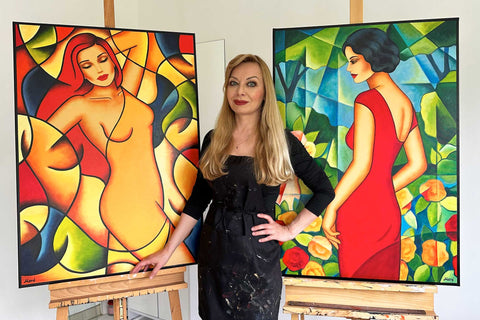
Flowism is my artistic counter-proposal to the fragmented view of Cubism. It arose from the desire not only to show new perspectives but to interweave them. Instead of separation – connection. Instead of analysis – resonance. Instead of fragment – flow.
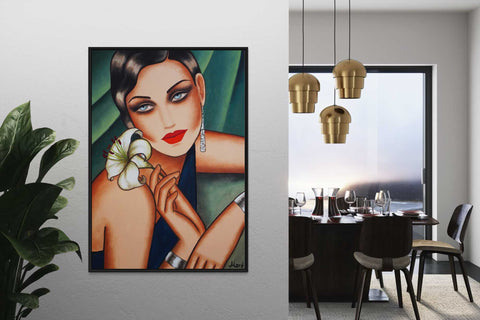
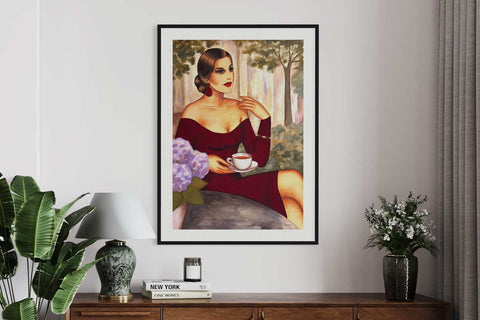
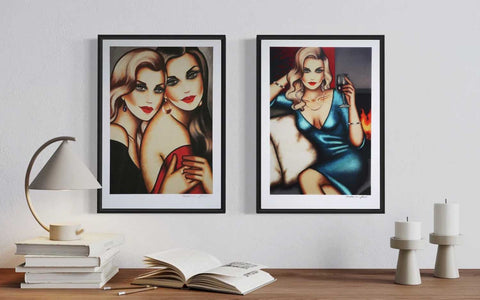
In my style, women are not at the center as objects, but as symbols of the soul. Their silhouettes are soft, their forms flowing, their presence intuitively palpable. Flowism works with transitions instead of edges, with light and color to make inner states visible.
I was inspired by Art Nouveau – but Flowism goes further. While Art Nouveau remains decorative and ornamental, Flowism aims to touch psychologically and emotionally. My art doesn't just want to please, but to remind – of what we often forget in everyday life: inner depth, connection, our own radiance.
In a world that is often loud and edgy, Flowism offers a space for feeling. It invites us not to analyze, but to immerse ourselves. Like water that penetrates everything, my art also connects the elements into a whole – full of movement, beauty, and meaning.
3. Female Portraits in Transition – Between Analysis and Intuition

How a woman is depicted says a lot about how she is perceived – and what is expected of her. In art history, women were often a projection surface: muse, beauty, myth. In Cubism, she was dissected, abstracted, analyzed – as in the portraits of Dora Maar. She remained enigmatic, but unapproachable. The emotional depth? Barely visible.
My female portraits aim to lift this veil. They show women not in roles, but in states. They receive, dream, gaze – and invite you to recognize yourself in them. In the "Colorful Emotions" series, for example, form merges with mood: the colors speak of longing, joy of life, inner strength.
It's not about ideals for me. It's about truth – the palpable, often inexpressible truth of female existence. And its luminous, divine origin. In my paintings, a woman can be everything: sensual and gentle, strong and vulnerable, lively and serene.
This change – from the analyzed figure to the feeling form – is for me the core of what Flowism can achieve: a new language of femininity in art.
4. Why Aesthetics is Regaining Significance

We live in a time when many people long for beauty, depth, and sensuality – precisely as a counterweight to an often over-analytical, abstract art scene. The desire for aesthetic experience is not a regression, but a breakthrough. A return to what art originally was: a space of resonance for the human.
Flowism addresses precisely this desire. It takes up the color-intensive, perspectival stimuli of Cubism – and gives them a new direction: connection instead of dissection, emotion instead of analysis. For many who feel attracted by the courage and complexity of Cubism, but miss the sensual, the soft, the feminine, Flowism offers a meaningful extension.
Because true aesthetics has nothing to do with superficiality. It is a language that makes the inner visible – in colors, lines, gazes. Flowism reminds us that beauty is not trivial, but significant. And that femininity in art should not be stylized, but experienced.
5. Flowism vs. Cubism – The Differences at a Glance

While Cubism focuses on fragmentation, geometry, and intellectual analysis, Flowism stands for flowing transitions, emotional depth, and psychological resonance. Cubist works often appear distant, experimental, almost cool. Flowist paintings, on the other hand, invite connection – with oneself, with the image, with the theme of femininity.
The use of color is a key difference: While colors in Cubism are often used structurally, in Flowism they radiate symbolically and warmly. Female figures in Cubism appear analyzed or abstracted – in Flowism, however, they encounter us powerfully, sensually, connected.
Both styles open up new perspectives – but they lead in different directions. One looks through the prism of form. The other traces the essence. Both can be art. But Flowism is an invitation to feel.
Perspective:
-
Cubism: Fragmented, multi-perspective, intellectual
-
Flowism: Flowing, organic, emotional
Emotion & Impact:
-
Cubism: Distant, analytical, often cool
-
Flowism: Sensual, psychologically deep, inviting
Aesthetics & Stylistic Devices:
-
Cubism: Geometry, hard edges, structured composition
-
Flowism: Flowing lines, soft transitions, rhythm
Image of Women:
-
Cubism: Fragmented, abstracted, object-like
-
Flowism: Powerful, connected, feminine-symbolic
👉 Discover more about Flowism:
➤ Article: "How Cubism Inspired Me – From Picasso to My Flowism"
➤ Article: "Flow Meets Flowism: The Path to Creative Ease"

Perhaps as you read, you feel that this perspective on art touches you – this different way of seeing, feeling, interpreting. For me, Flowism is not just a style, but a commitment to beauty, depth, and the feminine principle in art.
If Cubism fascinates you, but you feel that it lacks the lively, the sensual, the connected – then I invite you to discover Flowism.
👉 Discover my female portraits in the Flowism style now – and find the picture that speaks to you: To the Online Gallery.
6. (FAQ) Frequently Asked Questions
What distinguishes Flowism from Cubism?
Flowism focuses on flowing forms, emotional depth, and symbolism. Cubism, on the other hand, works with fragmentation and intellectual analysis. Flowism invites you to feel, not just to think.
Is Flowism a recognized art movement?
Flowism is an independent contemporary style that I developed. It combines elements of Art Nouveau and modern portraiture – with a focus on femininity, movement, and psychological resonance.
Why do your works mainly feature women?
Female figures in my paintings symbolize the soul. They embody intuition, sensuality, and depth – qualities that are often not visible enough in art.
What makes Flowism interesting for art collectors?
Flowist works are more than decorative. They are emotionally touching and at the same time offer a stylistically independent visual language. For many collectors, the interplay of symbolism, aesthetics, and expression is particularly valuable.
Where can one buy works in the Flowism style?
Originals and selected editions can be found directly in my online gallery as well as on partner platforms such as ars mundi or in the AIDA art galleries.